Monday, July 29, 2013

Bethlehem

Yesterday, with other foreign friends from Hebrew U, I went to Bethlehem.  (Bethlehem is in Area A, Israelis are not permitted to enter.) To do that you take the blue and white Palestinian bus from Damascus Gate (or along the Hebron Road) and ride south. Only 7 km separate Jerusalem and Bethlehem physically -- they are closer than the middle of Burnaby to the middle of Vancouver --but, of course, these days they are not part of a contiguous metropolitan area. Moving between the two requires passing through the checkpoint.

Here's a map of the area found in St Catherine's Church:
Bethlehem mosaic map - Milk Grotto, Jerusalem, Shepherds' Field


When you do get to Bethlehem, it looks much like Jerusalem, but more like East Jerusalem because the signs are in Arabic (and its socio-economic composition is similar). It's hilly with white Jerusalem-stone faced buildings. The streets are narrow and windy in the Old City near Manger Square. There are hummus and falafel shops, churches, and mosques.

Manger Square Bethlehem
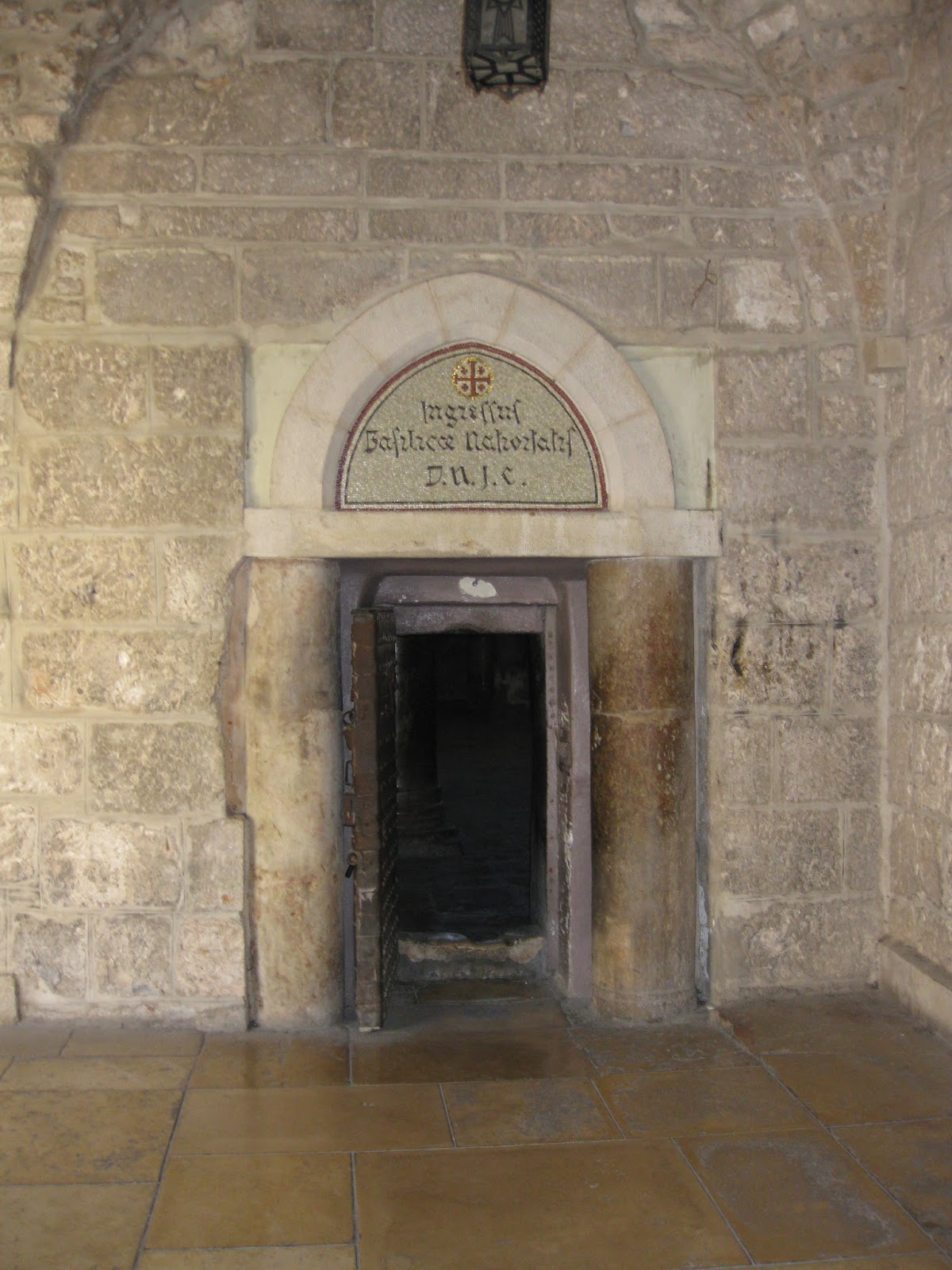
The main attraction in the Old City of Bethlehem is the Church of the Nativity, sitting atop the reputed birthplace of Jesus. Commissioned by Constantine in 326 CE, the Church of the Nativity is the oldest continuously operating church (as in, it never served as a mosque). The entry to the church is through the Door of Humility, a small Ottoman era door around which you can see larger doors once existed. The door is about 4 ft high:

Door of Humility
 Once inside, the orthodox feel of the church is immediate.

Inside the Church of the Nativity
Parts of the original 4th Century mosaic floor can be viewed in the main hall:
4th Century mosaic floors


For pilgrims, the key site in the church is the Chapel of the Manger, this is the specific spot where Jesus is said to have been born. On one side of the grotto (the chapel is below ground level), is the scene of the nativity, the other is the Altar of the Adoration of the Magi.

The Star

The Crib

Adjoined to the Church of the Nativity, along a hall:

exiting from Nativity to St Catherine's


through a courtyard
Courtyard in front of St Catherine's church


 is St Catherine's Church:


St Catherine's Church
St. Cath's is famous as the site of Christmas Midnight Mass, broadcast around the world on Christmas Eve.

There are other sites to see in and near Bethlehem: the Milk Grotto, Shepherds' Field, Rachel's Tomb, and Mosque of Omar. And, there's the Herodium, built by King Herod around 20 BCE (the same guy who built Masada), but the idea of hanging around too long outside in 30C at 3pm yesterday was not in the least appealing. So, we wandered the souk a bit:

curtains

main mall

bottleneck
Then we headed back to Manger Square to hire a taxi to take us to the checkpoint.
Manger Square
A post about checkpoints is upcoming.

Monday, July 22, 2013

Sad news...

One of my erstwhile flatmates is missing:

oh no!
As much as I don't miss Tina peeing in my laundry basket when she really felt I ought to have been paying more attention to her, I was very saddened to learn that she is lost. It's been more than a week. Yarden, Tina's BFF, is heartbroken, so I'm holding out hope that Tina planned a short vacay from the neighbourhood and will BRB. But, I have two nagging thoughts: (1) construction sites abound near the house right now with no shortage of places where a little dog could meet a nefarious end; and (2) Tina is a seriously elderly pensioner and  she might just have left home for the final journey. 

Sunday, July 21, 2013

Maccabiah 2013

It's the Jewish Olympics! They are a bit like the Commonwealth Games, in that they are a subset of international sporting competition in the sense that they are not quite the Olympics. Held every four years in Israel, the Maccabiah is open to Jewish athletes from around the world and all Israelis regardless of religion (so Arab Israelis can win medals). Still, casual observation (reading the newspaper) suggests many athletes are drawn to the games to be among people with a common (Jewish) identity (that's what the athletes say).

Maccabiah 2013 flags
Sidewalk stencils


This, the 19th Maccabiah Games, opened Thursday night and will run until July 30th. With some 9000 athletes representing 78 countries this is a pretty major sporting event. Bibi and Shimon were at the opening ceremonies, I wasn't. Reports from Teddy Stadium note that Bibi was able twice in his speech to state that Jerusalem is Israel's "eternal and undivided capital". This is a phrase he uses frequently (if you've listened to his speeches in the US you've heard this). So, we're clear on Bibi's starting point for any peace discussions on the status of Jerusalem. On that front, Bennett is still in the coalition. To Washington we go, next week. Just don't anybody hold her breath...

Saturday, July 20, 2013

Peace Process?

It seems John Kerry's political capital has shot up over the last few days. What had been widely panned as his bumbling and hopeless efforts to reignite the peace process have suddenly produced fruit, perhaps more due to the EU's threats of sanctions, but that might be neither here nor there. For now, let's focus on the fact that the parties might just start talking.

Embarking on peace talks for either Israeli or Palestinian politicians is a potential political minefield. Of course, many of each side's constituents want peace, but they have radically different conceptions of what that might look like and from where they might want to start that process. For example, on the Israeli side, the governing coalition, led by Bibi, includes Naftali Bennett, leader of the Jewish Homeland party. Bennett was elected on a platform that included a one-state solution: he suggests there is no viable Palestinian state west of the Jordan river. If the terms of the proposed negotiations with Palestinians are to start from 1967 borders, Bennett has threatened to leave the ruling coalition. We shall see.

Among the main issues that have proved so intractable in Israeli-Palestinian peace talks are:
  1. the status of Jerusalem
  2. borders; land swaps for settlements
  3. right of return for Palestinians (e.g. some 70% or more of Jordan's citizens consider themselves to be Palestinians)
  4. Israel's security concerns; recognition of the state of Israel
  5. emotional wounds related to the conflict
It's true that many people have lost faith that peace is attainable here, but at the same time, everyone (I know in Israel) wants the conflict to end. From the mothers who from the moment they birth a son (daughters have more options) know he is destined to serve in the IDF with unknowable consequences, to the teachers who bid their senior students goodbye to an uncertain future (not a four year undergrad degree), to the veterans who have served and stay on reserve to protect Israel, to those who have seen, in action, that the occupation exacts real costs from Israel: There is a resounding chorus of "enough". Obviously, it is a huge leap to think Israel's defence concerns will be resolved if peace with Palestinians is made; it is uncertain how countries in the neighbourhood will respond to a peace between Palestinians and Israel.

Still, let's hope for progress on peace.

Saturday, July 13, 2013

Keeping Time

Today I finally visited the museum in my neighbourhood -- the LA Mayer Museum for Islamic Art. I say finally because this museum is open on Saturdays when few other things are and it is easy to walk to from any of the 3 places I have lived.  Inevitably, I found other things to do on Saturdays. As it turned out today was perfect. It's gotten rather hot; the museum was a welcoming air conditioned refuge. And, with few other people in attendance there was no jostling for position in front of exhibits. Sadly, the exhibits on early Islam and Ottoman Art were both closed today.

Opened in 1974, the LA Mayer was founded with the objective "to promote within the Israeli pubic an interest, appreciation and understanding of the cultural heritage and artistic achievements of the Islamic peoples". The museum exhibits Islamic art (ceramics, metal objects, jewelry, and textiles, and weapons) of the Islamic dynasties over one thousand years; in some ways it is the not flashy, little sibling of the Doha Museum of Islamic Art. Small but fantastic in Jerusalem is the "Harrari Hoard" - a collection of eleventh century silver found in a ceramic jug somewhere in Persia, presumably stashed by a wealthy merchant under duress and found centuries later. The fine craftsmanship seen in the museum's collection is a reminder that we do indeed stand on the shoulders of giants.

The Museum includes space for seasonal exhibits by contemporary Islamic artists. On right now is "Between Sorrow and Beauty" by Fatma Abu-Rumi in which she explores "the tragic condition of Arab women".

Also housed in the museum is The Sir David Salomons Collection of Watches and Clocks. Totally amazing, incomparable; a delight. Two famous things about this collection:
  1. It includes a watch commissioned (possibly by her lover - the intrigue!) for Marie Antoinette and not finished until long after the guillotine finished her. The watch contains every "complication" (bit of technology) that was available at the time.
  2. 106 pieces of the collection were stolen in 1983;  to date 96 pieces have been recovered (read the story at Wikipedia's LA Mayer entry). Details of the heist have become part of the exhibit.
I have always loved watches and been fascinated by the practice of timekeeping so this exhibit was a great treat. Breguet's genius is overwhelming: perpetuelles, the sympathique clock and its watch, and the montre a tact (the indiglo of the 19th century -- you can tell time in the dark by feel on the side of the watch).

The LA Mayer is a very good small museum; a neighbourhood treasure.

Monday, July 8, 2013

My favourite local summer refreshment

With apologies to Jane Austen, "It is truth universally acknowledged that a hot summer day puts a person in need of a refreshing drink."

The best microbrew in Jerusalem is Taybeh, made in Palestine. 


Taybeh is by far the best brew in town, but you cannot get it everywhere. A discerning liquor store (the one on Agrippas across from the market) sells it for NIS 11 a bottle (it was 10 until the VAT went up in June); it's not a cheap drink, but well worth the price. It is also available on tap at one bar in West Jerusalem.

Tuesday, July 2, 2013

A bus stop

Earlier tonight...

18:37: I get on the #18 bus at Mahane Yehuda. I have two full bags of groceries. Not plastic bags - my backpack and a messenger satchel -- it's a packhorse of a shopping trip. I just moved into my new place on Saturday and I needed stuff, lots of it. My friend Amit and I shopped together; we parted at the bus stop, he walked home. I chose the bus because (1) I have a lot of stuff today  (2) the bus stops just a block from my new place and (3) I have a bus pass. The bus was a no brainer.

18:40: Finally, everyone and their shopping cart has loaded. The bus is packed. To get from Mahane Yehuda to the German Colony (mostly due south)  the buses first go northeast to cross Jaffa Road (the tram tracks) and then east, before changing course south east, then south, to head through the city centre, where they cross back over the tracks. If you followed that, it's a bit of a loop. If you walk, you don't have to cross the tracks; you stay on the south-west side.

18:45: There's a bus stop on King George Street just before the tram tracks on Jaffa. We stop to pick some folks up.  And, we don't leave the bus stop. There are police vehicles in the intersection. The tram is not running. Police officers are reeling out streamers of red do not enter tape. There are crowds of people on the sidewalks and in the road. People are being evacuated from the shops all around the intersection. It seems the problem is somewhere east of King George, but there is no view down Jaffa unless you are standing on it; the buildings are set right at the corners. I'm sitting on the bus, so my view is limited. I could get down, but there is no where to go. Pedestrians cannot cross the intersection. Gathering crowds of Israelis are waiting, chatting on the phone, smoking.

18:50: The bus driver turns the bus engine off. We sit and wait. Crowds of pedestrians grow. The speculation is that someone left something on the tram or at the tram stop. The bomb robots have been called in to remove the threat. 
 
18:58: The bus driver starts the engine. He's been asked to move the bus. It must be because of the coming explosion. Security wants our bus further out of the way. We back up about 7 metres. The engine idles.

19:25: An explosion. A few screams -- of surprise -- in response to the sound.

Wait. Wait. Wait.

19:28: Another explosion. No screams. The bus continues to idle, the air conditioning blasting away. It's not even hot today, maybe 25C. At this rate we'll run out of fuel before we get to Emek Refaim.

People are still waiting. In the streets there are seculars, Orthodox, Haredim, Arabs...maybe Jerusalem doesn't need the F1 to get people of all sorts to stand in the street amiably.

19:40 A police van enters the intersection and the pedestrians make a break for it, ducking under the red police tape. The bus has a green light, but we don't move -- the intersection is full of pedestrians.

19:43 We are still waiting at the intersection. There's an acrid smell. And several emergency vehicles. Finally, we cross the tracks again.

The event doesn't make the news. No one is hurt. This is life in a country that has been plagued by terror. No chances are taken.