Friday, September 20, 2013

Sukkot (2013)

Sukkot - the festival of outdoor eating and the four species - runs from September 18 to 25 this year. The best sukkah sits atop the glass dining room of the Prima Kings hotel at Paris Square - it seems to emerge from a bed of flowers. It's really spectacular. Sadly, I didn't have a chance to take a photo.

It being Sukkot, the university is closed and having experienced Sukkot, I thought this year I'd go on vacation.  I'm in Switzerland visiting my friend TT - my travel and office buddy from last winter. I deplaned Tuesday to a cool and wet evening (rain - it's been nearly 5 months since I've seen rain!) that was admittedly a bit of a shock as last weekend it was 35C in Jerusalem; it was 12C in Zurich. Things have warmed and dried out a bit and I am adjusting to autumn weather - closed toed shoes, long pants, a cashmere sweater, gortex, and an umbrella! More shocking than the weather might be the clean streets, the orderly queuing, CHF 6 for a coffee at Starbucks (WTF? your coffee isn't worth NIS 6), awesome trains, surface water - lakes and rivers, and GREEN everywhere!

So far it's been rather a busy week; we've all been working. We ride the train to Zurich, leaving the house at 730, walking to the station. The train takes about 20 mins to get to Zurich. I go to the library at the university while TT is at work, and when the weather lifts, I do a wee bit of sightseeing and shopping (fall boots!). Today we got a lift to Basel with TT's partner who works there, where I also worked at the uni library. In the afternoon we visited the Kunstmuseum of Basel which has a rather impressive collection including maybe a bit too much 15th century art depicting the passion of Christ and other key events in Christianity. However, we did have a bit of fun considering whether the pictures were a reasonable depiction of the Old City of Jerusalem and Ein Karem (there were paintings commemorating the Visitation and the birth of St. John the Baptist). Moving forward a bit in time we saw some great Renaissance works including Rubens and Rembrandt, and Pieter Brugel the Elder's Triumph of Death, which comes off as a bit apocalyptic...and perhaps timeless. The collection includes Impressionist pieces (Van Gogh, Monet, Cezanne, Gaugain, Pissarro, Manet, Munch); excellent work by Swiss painter Ferdinand Holder; creepy Dali; great Picasso pieces and some from before he became a Cubist. And, a few pieces by Marc Chagall, he of the windows at Hadassah Ein Karem.

We're planning an excursion to the Alps in the next few days as the weather is meant to clear considerably.

Saturday, September 14, 2013

Yom Kippur (2013)

Talk about a car free day!  This is it. It's also radio-free day too (snow on all channels).

Just as last year, there are children everywhere on bikes or rollerblades, gleefully tearing around main streets that are typically filled with traffic. Yesterday, I started Yom Kippur on the east side  enjoying a meal out with a friend. As we were walking back west, we came upon people leaving synagogue, filling the streets. The youth were holding "sit-ins" in the middle of main intersections (Paris Square, for example) -- sitting in circles, chatting and singing. The day is about atonement, but the atmosphere in the street is happy (not exactly festive, but communal) with the observant dressed in white. As Yom Kippur ends, I'm sure people are more eager than ever to break the fast: it's been a weekend of a heat wave (35C) making the fast more punishing than usual.

This evening I went for a walk through the Old City to the Kotel (Western Wall) as the sun was setting. It was especially peaceful and busy. I'd have pictures to share if use of cameras were considered appropriate on Yom Kippur/Shabbat. Security searches were all manual too.

Next holiday starts Wednesday evening - Sukkot.

Wednesday, September 11, 2013

Fruit of the month: Guava

Guavas have arrived at the market. The first time I met a guava was when a friend of mine who had spent time in Hawai'i served me POG (Passionfruit, Orange, and Guava) juice. I've since had the opportunity to eat guavas in tropical places and they've never been my favourite. I think it has to do with the seeds. If your small guava has many seeds it can be a very crunchy experience, but the seeds are like concrete so it can be a bit unpleasant. I have just learned, eating guava in Israel with my fruit expert friend, that you want your guava very ripe and you want to swallow the little seeds - don't attempt to break them down. This has improved my experience eating and feelings toward guavas.


I'm not sure what variety these are, but they are not any of the apple guava varieties - those are shaped like apples and of a different colour.  These guavas are yellow, pear shaped and pear sized, with wrinkly stiff skin. To eat: wash and go. The texture is smoother than a pear, but with these little seeds in the centre. I suppose one could scoop the seeds out, but I've never met anyone who does.


Guava half - centre of little seeds

Guavas are fragrant! There are few fruits as smelly as the guava. For the most part it is a nice smell, but it can become overwhelming. I left a small box of guavas on the kitchen counter last night and I woke up to the smell of guava having permeated every corner of the apartment.

As noted in the pomegranate post - guavas are in the same order as pomegranates (like second cousins). Here you can see a bit of resemblance - the flower end of the fruits look like little crowns.


Flower end like a pomegranate

For the health conscious North American: guavas are great sources of fibre and Vitamin C! Enjoy!

Sunday, September 8, 2013

5774 & Athens

Shana Tova!


It's a new year in Israel; it's 5774. The High Holy Days commenced on Wednesday evening. I attended two Rosh Hashannah dinners (two nights in a row, as is the custom) followed by a Shabbat dinner because this year they ran together. That's more food than I'd like to see for a while.

Rosh Hashannah dinners are characterized by sweet foods. All the rest of the year the challah is a braided loaf, at Rosh Hashannah it is a braided circle, to symbolize the cycle of the year. All year, challah is sprinkled with salt (alluding to the Temple sacrifices?), but at Rosh Hashannah and during the High Holy Days it is dipped in honey for a sweet new year. Also, apples are dipped in honey, pomegranates are eaten, and a few other foods depending on the table you are at and which blessings are being done.

Then it's on to the fish, the soup, the salads, the meat (chicken and beef and maybe more than 1 dish of each), vegetables, potatoes, and rice. Always followed by dessert, something parve if it's a kosher table, or something dairy if it's not, but it will be sweet! Apple cake is very common (and yummy). I also ate an amazing cheesecake made of millet at a vegan Rosh Hashannah dinner and an apple pavlova at a non kosher dinner. It was an eating weekend!

Daylight Savings or Not?


And today Bug 2013 hit Israel.  Since 2005, daylight savings time in Israel has ended the Sunday between Rosh Hashannah and Yom Kippur (which follows a week later). This is ridiculous and I don't know the details of this particular political decision (something about orthodox and seculars compromising?). Rosh Hashannah occurs at the earliest on Sept 5 as it did this year; at the latest it will occur on October 5 (because of the lunar calendar). Having daylight savings end in September or early October is punishing. At least, that's how I felt about it last year: Dark evenings way too early in the season and ridiculously bright early mornings. It felt like I'd missed 6 weeks overnight. I guess I wasn't the only one who didn't like it: the secular Israeli population had been complaining since 2010. In November 2012,  the Knesset extended IDT to October 1, but that didn't seem to appease enough people because earlier this summer (July), they extended it to October 27, 2013. Yippee!

Except, it seems no one sent the memo to the tech industry. As Ha'aretz put it: "Israeli smart phones cannot tell time." Sure enough, it seems that most operating systems didn't install a fix for the law that was passed by the Knesset in July. I woke up at 7 this morning and looked at my phone for the time. It said 6 and I thought, "Hmmm, really? It's rather bright out." But, then I dozed off until the jackhammering across the street started and in my fog of grogginess thought: "No, they never start before 730. Wait, what's going on?" Once I made it to my computer and saw the same time as on my phone I was confused for a while. When I found my watch, I discovered there was a problem. The devices in the house that rely on operating systems both thought IDT was over. I did manual resets of time, but I've since learned the recommended fix is to set your timezone to Athens - same time zone, same end date for daylight savings. After 27 October, we can switch back to Israel time. I'm glad I'm not relying on Outlook for my calendar; love my Moleskine! Still, the Athens fix hasn't removed the problem entirely. Gmail seems to think IDT is over too. All of my emails have the time stamp off by an hour. Flux, the lovely screen dimming add-on, also thinks IDT is over and has started darkening my screen at a quarter to six.

Maybe convergence of technology is not all it's cracked up to be. Maybe having a single purpose device like a watch is still worthwhile.

Wednesday, September 4, 2013

Stuck in between

Tensions in the Middle East have been simmering all summer. Starting in late May, the Istanbul protests over the fate of Taksim Gezi Park were met with violent suppression. In mid June, the White House reported that the US Intelligence Community had "high confidence" that Assad had used chemical weapons multiple times over the past year. In late June, Cairo erupted and continues to roil. In July, terrorist activity in the Sinai intensified, building off an officer hostage crisis in May. Then on 21 August, in the course of a Syrian government attack to oust rebels from Ghouta region (east of Damascus) chemical weapons were used: reports suggest more than 1000 noncombatants were killed.

We're off simmer, tensions are rising. In Hebrew, you might say we have a "balagan gadol" - a big mess - on our hands.

We have Cameron, Hollande, and Obama saying lots, much of which hasn't been all that coherent. Although frustrating, it is reasonable that Obama has sounded contradictory. It's a clear violation (no blurred lines here!) at international law to use chemical weapons. If you're going to belong to a system (global governance) that sanctions particular acts, then you have to be willing to enforce the rules. And Obama is willing to enforce, but he doesn't want to engage in the Syrian civil war. In the global system it's the UN Security Council that is meant to enforce the rules, not individual states. (What happened in Iraq was the global equivalent of vigilantism and illegal under the current rules of international law.) With the Iraq War still fresh in everyone's minds, we're seeing a more cautious approach (asking the people's representatives) to taking action against Syria. The mounting evidence seems clear that chemical weapons were used, it's difficult to prove who used them but experts say that only the government in Syria has chemical weapons capacity. Will Obama go with or without the approval of his legislative branch? Will Obama go with or without a UNSC resolution? Stay tuned.

Meanwhile, Syria has said that if the US attacks it, Syria will aim missiles and God knows what else at Israel. Why? Well, it's part of the Middle East geopolitical game. How real is the threat? I have no idea: among the pundits there's a spectrum of concern. The Israeli Ministry of the Interior has decided the threat is significant enough to warrant the issuing of gas masks. If you are an Israeli citizen you are meant to queue at the Post Office and get your gas mask. In a CBC story yesterday (Sept 3) about the illegality of an attack without a UN resolution, it was reported that:

Tensions are high among Israelis despite calls for calm from the government, according to freelance reporter Irris Makler. The country's military has noted there is a chance Syria, if attacked by the U.S., might then retaliate against Israel. People in the street are nervous. They're lining up to get gas masks, which are government-issued. They're fighting each other in the queues," Makler told CBC News.
It's true there have been reports of people lining up to get gas masks and fights in the queues. Still, I suspect the fighting may be due to two factors: the "reason" (substance) people are lining up and the "doing" (process) Israelis truly despise queuing. In other words, I am suggesting that the two operating together are piling up the stress. And, I'm not being trite here: queuing and waiting doesn't bring out the best in anyone and Israelis are particularly good examples of this. 

Do I have a gas mask? Funny you should ask. As a non citizen, the Israeli Ministry of the Interior has not invited me to collect a gas mask. I contacted the Canadian Embassy to see if they had a gas mask for me. I had pointed out in my email request that as a non-Israeli I had not received said invitation from the Ministry of the Interior (or any other Israeli ministry).  Here's part of the response I received:

1. Please be advised that your inquiry goes beyond the mandate of The Department of Foreign Affairs, Trade and Development Canada (DFADT). The Canadian Embassy is not distributing gas masks to Canadian citizens. The Embassy of Canada understands that the Government of Israel is providing gas masks exclusively to Israel citizens at this time. As your inquiry relates to the local Israeli Authorities, you may address your inquiry to the nearest office of the Israeli Ministry of Interior for the most up to date information.

This left me wondering: GWN Embassy can you help me at all? Well, they did tell me where to buy a gas mask. And, they have suggested I check the IDF Home Front Command website. I'm feeling a bit like the State of Israel might be feeling -- stuck in between. Anyway, gas mask shopping will have to wait until the stores open up after the holiday. The veterans all maintain that Jerusalem will never be a target. Insh'allah.

And with that, I'm off to celebrate Jewish New Year. And, a year by the Jewish Calendar, of living in Israel.

Shana Tova!

Saturday, August 31, 2013

Apprenticing in Archaeology

Last Wednesday I visited a friend at the site of her dig in Tiberias. Anna (we were flatmates this summer), is an archaeologist who specializes in pottery. She has done work from the Hellenic period through to the Ottoman. She's currently digging at a 9th Century Abbasid settlement. It's located about 2.5 km south of the centre of Tiberias. And just next to the Hamat Tverya National Park where a 4thC synagogue has a preserved mosaic floor. (I missed this!)

Tiberias is an OLD town, dating from about the time of Jesus. It was built by Herod's son, another client king of the Roman Empire, hence its name which pays homage to the Roman Emperor Tiberius. The city sits halfway up on the western shore of the Kinneret (aka Lake Tiberias, aka Sea of Galilee). The area is replete with Christian and Jewish holy sites, and with tacky tourist hotels and falafel-shwarma shops. The Israeli Tourism Ministry markets Tiberias as a place for combining a relaxing vacation with visits to historic and holy sites. That's about right because you can swim in the lake (next to which Jesus did much of his work) and visit the hot springs for which the area has always been famous. Everything is all wrapped up together.

south end of Tiberias, looking at the Kinneret
My apprenticeship on the site started just before 8am with a tour of the site, which is a narrow strip of 6m set in about 15m from Hwy 90 (running alongside the lake) for about 200 m.

the site

The site workshop
Much of the site is perplexing the team of archaeologists. They are sure about a few things and totally confounded by  others. Part of what makes it tricky is that it is definitely 9thC but, the Abbasids cleverly reused Roman blocks and, evidently, re-purposed several structures.


A square on the site

All of this has created some discontinuity in the site. In a perfect world, the team would expand the area of the dig and extend the dig for another six months. But, the world is imperfect so the dig will wrap up in about a week.

Since Anna is a pottery specialist and I was her guest on the site, my apprenticeship was focused on pottery.

buckets of shards

I washed pottery to the soundtrack of fighter jets (cruising the Syrian border; that's a subject for another post or not). Sadly, I don't have a picture of me washing, but honest, I did! I was sitting in that empty white chair next to these two guys.

pottery washing station
Here's how you wash pottery:
You get a bucket of clean water and your bucket of pottery shards that have been soaking in water for a few hours or a day. (This is a good thing because your pottery shards have been caked in mud for nigh on a millennium!) And, you get a nail brush. Reach into the bucket of pottery shards and select a shard. Dip it in the bucket of fresh water and scrub. You will likely have 5 or more surfaces to scrub. And you should scrub pretty hard because it's the edges that are critical for the archaeologists to see in order to assess wear patterns and type of earthenware -- all of which goes to provenance. Dip your now cleaner (but really, not sparkly clean) shard in the fresh water to rinse and deposit it on the tray of clean samples. Repeat. Oh, did you get a shard that is disintegrating on scrubbing? That's a bone. Toss. Get another shard. Dip, scrub all surfaces, dip, deposit. Repeat. About an hour of pottery cleaning was enough to make me sure that a full day of it at 40C really wouldn't be much fun: it's back breaking, hand-shrivelling work.

Then it was on to sorting, which we did in the air conditioned trailer; I was grateful to be out of the sun. The outdoor work area has black mesh shade covering it, but it doesn't really protect you from the sun.


Sorting begins by laying cardboard down on a table top and dumping the contents of a bag of washed pottery shards on it.

Getting started

the hunt is on
Anna sorting
The first sort is by obvious features -- kiln bar (used in production), handle, rim, base, glazed, engraved. The shards lacking any of these obvious features are counted by type of earthenware and then disposed of. The shards of interest are then sorted by type of vessel -- jug, juglet (distinguished by placement of handles), lids and bases (distinguished by curvature of rim), cooking pot and pans (distinguished by burnt clay and thickness), and by type of earthenware -- buff, pink, grey, yellow (provenance).

glazed base and plain base


glazed shards
Not everything can be kept so if there are multiple pieces of a particular type, the best sample is selected. The glazed shards are sorted separately and grouped (in a small plastic bag - mini ziploc) if they appear to belong to the same vessel. The glazed shards are particularly helpful for research because glazing was so challenging and certain colours proved difficult to make in different regions due to raw materials available. So, glazed work can provide considerable information about where and who was making the pottery.

Along the way the archaeologist takes copious notes, counting and cataloguing the shards. This is a critical step as it will facilitate writing up the report later without needing to see all the pottery again.
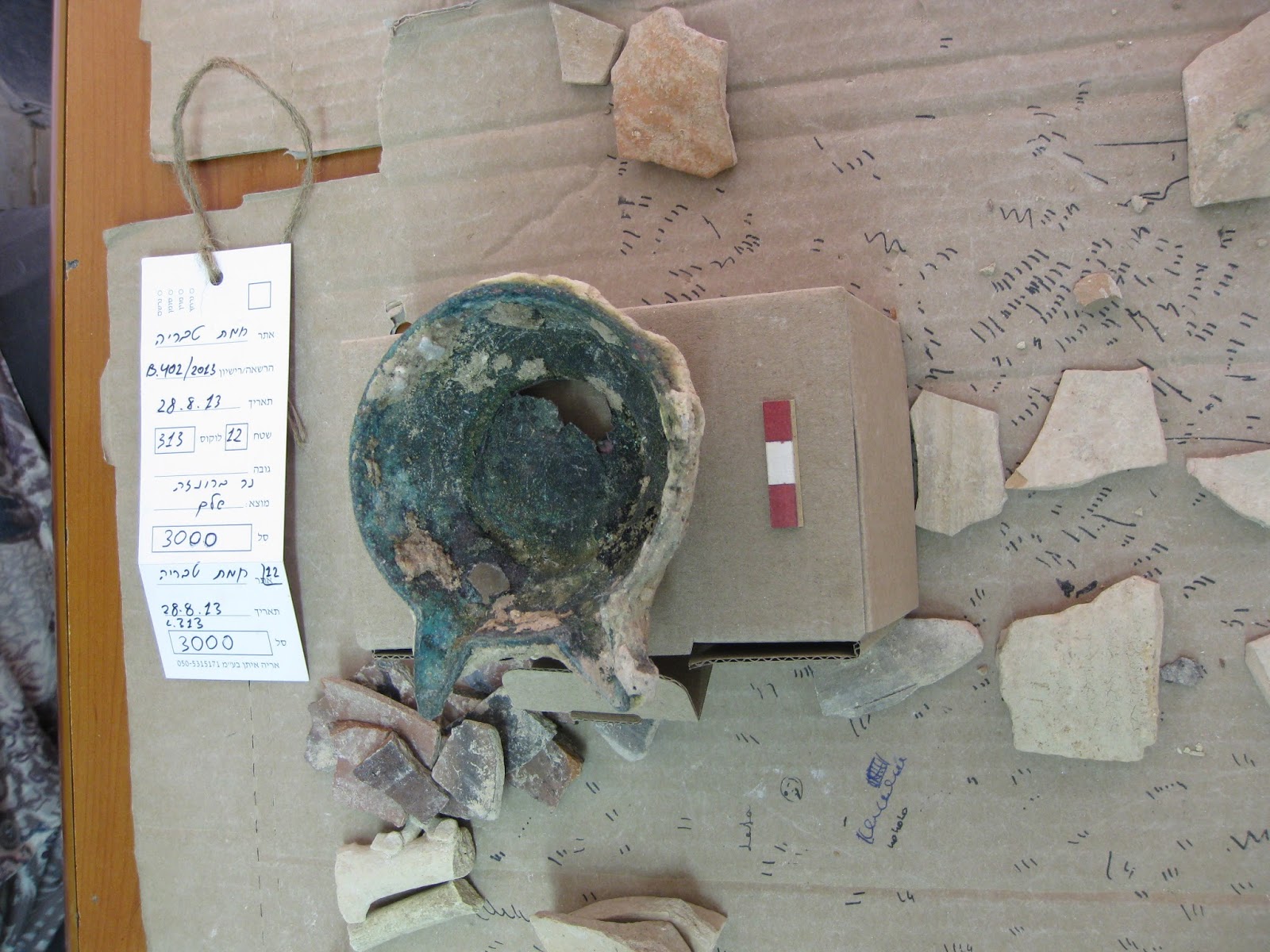
Everything was amazing, but highlights were a double spouted bronze oil lamp, a coin (not sure from when), and the glazed work. All of it is so impressive.

Bronze lamp
Once again I was humbled by the ingenuity of those who toiled with minimal tools. It was an awe-inspiring day.

Friday, August 30, 2013

Fruit of the month: Pomegranate

With the Jewish New Year just a flip of the calendar away, the pomegranate (Hebrew: Rimon) is everywhere: all over the market and hanging from neighbourhood trees.


Pomegranates grace the table at Jewish New Year - Rosh Hashannah - because they symbolize prosperity. In Christianity the pomegranate symbolizes Jesus' suffering and resurrection.


You would have to have been hiding under a rock in North America for the last decade to not know the  pomegranate and, of course, its nutritive value; the fruit has been well marketed as essential to the diet for all the vitamins and antioxidants it includes. Pomegranate martini anyone?

Fortunately, here the focus is on enjoying a yummy seasonal fruit that may grow in your yard. Pomegranates are not fast to prepare; you don't grab one on the way out the door to munch at the bus stop. Peeling a pomegranate and picking the seeds off the internal skin takes some time, although there are better and worse techniques for this. The easiest way (with the least muss and fuss) to consume pomegranate is in juice form. Here, many folks have at home a pomegranate juicer which looks something like a citrus reamer with a top press that can be levered down to squeeze all the goodness out of half a pomegranate.

Pomegranates are in the Myrtales family, not a flowering plant family overflowing with edible fruits. Cousins to the pomegranate include guavas, cloves, allspice, and eucalyptus.