Thursday, January 31, 2013

January Roundup

Forming a coalition

It's almost official: President Peres is now expected to ask Netanyahu to form the coalition, he's completed his consultations with various Members of the Knesset and party leaders. As I wrote a couple of days ago, this is not news, everyone has already starting jockeying for position and Bibi has been offering up portfolios.


Syria

I cannot say that the IAF attack on Syria's Jamraya military research center has become water cooler conversation yet, but I guess we'll see.


Weather

Winter returned yesterday. It's cold and raining (cats and dogs!). We were close to snow this morning. On the ride up to campus, the bus windshield was thick with slushy lumps. And, our living room is a pool again! Four, maybe six, more weeks of winter. It won't rain continuously, but we will be subject to these nasty outbursts. I cannot wait to stop wearing 3 layers of shirts and fleece and a down jacket inside all the time! And, I definitely won't miss my shift with the squeegee in the living room!


Gatekeepers

The first time I tried to see this movie, we had hoped for the early show; it was sold out, so was the late show. Extra screenings have been added at the Jerusalem Cinematheque, everyone wants to see it and lots of folks are talking about. What's it about? From the Cinematheque's website:
Charged with overseeing Israel's war on terror-both Palestinian and Jewish-the head of Israel's secret service, is present at the crossroad of every decision made. For the first time ever, six former heads of the agency agreed to share their insights and reflect publicly on their actions and decisions. The Gatekeepers offers an exclusive account of the reasons that each man individually and the six as a group came to reconsider their hard-line positions and advocate a conciliatory approach toward their enemies based on a two-state solution.
The Gatekeepers is nominated for an Oscar for Best Documentary.
The secret service is called Shin Bet -- basically they are the FBI equivalent. (Mossad is like the CIA.)  If you do go see this movie, I'd recommend brushing up on your history from the Six Days War of 1967 forward. Those of you who lived through that time as adults might find you remember enough -- the movie assumes a fluency with, and detail of, Israeli history that I just don't have yet.  For that reason, and that when you read subtitles it limits how much time you get to take in the film, I'd like to see it again.  My landlady, Hedda, saw the film a couple of days before I did.  When I told her I'd seen it she asked what I thought. I said, "Umm...it's profound and I don't think I've processed it." She said, "Ken, whywhywhywhywhy." Which is Hebrew for "Yes; I was overwhelmed in a negative way." Yup, it's a profound film. I saw the movie with an Israeli friend who said, about the movie, "It makes me want to cry." And, it makes the current government's position (and the likely new coalition) on the Palestinian issue all the more frustrating.

The Gatekeepers is a unique and profound comment on the Israeli-Palestinian situation. See it if you can.


Wednesday, January 30, 2013

Ein Karem

Way back at the beginning of December, on a fine weekend of weather -- clear blue skies and full sunshine with daytime highs of about 20C -- Theresa and I took full advantage and did two big walks in the city. The Friday we spent on the west side of Jerusalem in and around Ein Karem; on the Saturday we were on the east side of Jerusalem, up the Mount of Olives. (I haven't any photos of Saturday's excursion since my camera disappeared (magically) when we reached the top of the Mount of Olives and suddenly found ourselves in a crowd of touts!)


Ein Karem is a charming village on the far west edge of Jerusalem -- it's now effectively an upscale suburb. Reputedly the birthplace of John the Baptist, the village is filled with Christian landmarks.  We took the bus out to the Hadassah Medical Centre Ein Karem (this is where you find the famous Chagall windows, but they are not open for viewing at the weekend). Then we walked down into the valley toward Ein Karem.

The view from Hadassah to Ein Karem

Terraced agriculture -- found throughout the Judean Hills

On the footpath to Ein Karem


Along the way we saw the Moscobye Orthodox Russian Church, begun before WWI and finished recently:

The golden onions of the Moscobye (photo credit: T Tribaldos)

And, we stopped at the Church of the Visitation.


Church of the Visitation

Pop Quiz!


What visitation? Who visited whom? When? Why? The hint is in the mosaic in the pic above. The story is that Mary was pregnant with Jesus when she visited her cousin Elizabeth who was pregnant with John the Baptist. I have no idea why: perhaps because pregnant cousins want to hang out and catch up? Um, sometime before Jesus was born?

Mosaics of flora and fauna decorate the floor of the church:


After the Church we stopped in at Mary's spring. This is meant to be where Mary drew water to drink on that same visit to Elizabeth.

In need of scrub -- Mary's Spring


Later a mosque (see the minaret) was built over the spring

After stopping for coffee we moved on to visit the Church of Saint John which is built upon the spot where John the Baptist is said to have been born.


On the way to the Church of St. John

At the church

At the church

Ceramic plaques of a prayer in multiple languages at the Church of St. John


From there we hiked up to Mt Herzl (near to Yad Vashem).

Follow the Jerusalem Lion (the trail marker)

On the path to Mt Herzl
From Mt Herzl we hopped on the tram to Mahane Yehuda (the shuk) where we went for lunch.

The next day we (Theresa and I) walked west around the south end of the Old City, past the Zion Gate and the Dormition, down into the Kidron Valley, up to the Garden of Gethsemane. We stopped at all the churches on our way to the top of the mount. And, I took some great pictures! Alas, they left my possession along with my camera. So, we are planning to redo that hike and get some great photos. The view of the Old City from the east is truly magical!

Tuesday, January 29, 2013

Plus ça change...

The talks to form a coalition are underway and it appears that nothing new is on the horizon. Labour rejected an offer to join the government; they will stay in Opposition.  Bibi is contemplating his options. There are efforts to form a Haredi bloc; Yesh Atid (There is a future) and Habayit Hayehudi (Jewish Home) -- not the most obvious of partners -- are discussing a possible alliance. Apparently, Bibi has 100 days to form a coalition. I cannot imagine the backroom negotiations going on -- a serious chess game for politicians. I suppose if one feeds off that sort of thing, Israel is the place to practice politics. It doesn't get any better than this.

Meanwhile, the people have a bit of a hangover. Just wait a minute...who is this Yair Lapid (head of Yesh Atid)? He's a former tv anchorman (think a younger Peter Mansbridge) who is minimally educated, but attractive and charismatic. Just what is his centrist party's platform? And rega (wait), he's talking to Habayit Hayehudi? And, worse, just last night he announced on national television he doesn't know what portfolio to accept in the coalition (Bibi's people say Lapid can have whatever portfolio he wants - Finance, Foreign Affairs), but he is sure that one day he'll be prime minister.  His political career started last year (Jan 2012) when he left journalism to found Yesh Atid.

Generally, it seems like younger leftist voters were more excited by the election results than older voters. Older voters knew they were seeing the same wine in a different bottle. The centre in Israel tends to be (re)occupied by (new) parties that don't have overly grand visions; they tend to get broad populist support. This is not surprising; gradual change tends to work well for folks who are doing reasonably well in life. (I cannot relate any stories from more right-leaning voters -- I don't know folks that vote that way well enough to learn more of their opinions.)

For people who see Israel in need of an acute policy overhaul (addressing economic inequalities, limiting state support of ultra-Orthodox and requiring them to be in service to the state (army, civil service), managing immigration, addressing Arab-Israeli issues, and finally, resolving the Palestinian issue) the centrist position is frustrating. It means little change can be expected.  And, with life in Israel on the decline, not just economically (for many) and social tensions (inside and outside) on the incline, well, this is desperately frustrating.


Wednesday, January 23, 2013

There is a future (Yesh Atid)!

The Israeli election results are far more exciting than expected. Yesh Atid (There is a future) led by Yair Lapid has captured 19 seats. This is gobsmacking. It means a centre-left party holds much more power than expected. The most likely scenario (as of now) is a Bibi-led coalition with a thorn of centre-left in his side. As of tonight it appears the Ultra-Orthodox (Haredi) and the upstart Bennett-led Jewish Home Party don't have enough seats to join Bibi to form a right wing-Haredi government.

Secular leftist Israelis are optimistic that they will see a more centrist government in 2013. (How long it will last is another question altogether.)  If the Haredi parties are excluded from the coalition, there may be a real opportunity to reform some serious social policy issues in Israel. As for progress on the Palestinian issue, well, that's less clear.

For now, we wait -- until President Peres asks a coalition to be formed sometime next week. Until then, the pundits will be busy with predictions.

Monday, January 21, 2013

Election Eve

Tomorrow is Election Day in Israel. It's a quasi-holiday -- universities, schools, and offices are all closed. But, apparently coffee shops are open and buses run. Sounds like a weekend back home. Polls are open from 10h-22h and the results come back the next day. Can you imagine Canada? What if we had to go to bed not knowing who had won and by how much?

I cannot add any insight to the elections or tell you any great anecdotes. Being Hebrew illiterate and essentially Hebrew-deaf (besides the basics) means I'm insulated from most election talk and all election shenanigans. As I wrote in November, Bibi has apparently got things sewn up with Lieberman at his side. The interesting question in this election isn't who will win, but rather by how much. And, how the left will be represented in the Knesset. We'll have an answer on Wednesday.

As for all that disturbance that Operation Pillar of Defence caused back in November - it's water under the bridge in the daily life of Israelis. Everyone knows Hamas will restock weapons, Israel will make improvements to the Iron Dome (missile defence system), and the dance will continue.

Sunday, January 20, 2013

By foot, then take the train

Snow? What snow? It's balmy in Jerusalem. Ten days later and we've got highs of 16C. I'm beginning to understand the "grin and bear it" attitude to winter around here. Anyway, last weekend we escaped the snow of Jerusalem for the Coastal Plain.

What's on the Coastal Plain? It's that bit of Israel that hugs the Mediterranean before you head east to the West Bank or the Judean Hills or south into the desert. Specifically, we went to Ma'abarot Kibbutz because that's where Amit grew up. Ma'abarot is a bit north of Netanya and a bit inland from the coast. At that point, Israel is a narrow strip of about 9km.

On Friday morning we went to Caesarea National Park. There's been something at Caesarea pretty much continuously since about 500 BCE. In what's becoming a familiar pattern, the usual suspects set up shop on site after defeating the previous group. So, first the Phoenicians then the Greeks and Hasmoneans, followed by -- you guessed it -- the Romans! King Herod (the Roman client king of Judea and generally busy guy about whom I'll have more to say in future posts) really made Caesarea into what it is now known for. As a planned city, Caesarea had a road network, a temple, amphitheatre, markets, residential quarters, and -- of course -- an aqueduct!  Also, Caesarea has a great natural harbour.

Jews and Gentiles lived together until the Great Revolt by the Jews in 66 BCE (more on that later -- when I tell you about my trip to Masada this weekend). Later Christians, Pagans, Jews, and Samaritans lived together. In the Byzantine period the city was extended and fortified. Following the Arab conquest in 640 CE, Caesarea became a sleepy town for a couple hundred years. The Crusaders showed up and conquered the city which they held until 1265 when the Mamelukes destroyed it (despite the Crusaders' improved fortifications). In the late 1800s the Ottomans settled Bosnian Muslim refugees in Caesarea. Today it's a touristic site -- more coffee shop than national park. On the day of our visit parts of the site were underwater; Jerusalem had snow, the coast had buckets of rain.

Some pix (photo credits Theresa Tribaldos):

The Amphitheatre at Caesarea

Looking North from the Amphitheatre (the flooded bit on the right of the walkway is the old Hippodrome)

Rocky outcrop at Caesarea's Harbour


Mosaics in the residential quarters

Deciphering the ruins -- I think we found the laundry rooms

At the kibbutz we hung out and ate, visited the kibbutz zoo (just like at Neve Ur, there's a zoo), walked, went mushroom hunting, and ate some more. Yep, it's really hard work visiting a kibbutz. No one puts you to work -- unless you count shelling pecans so you can take a bag home -- and everyone feeds you (Yemeni specialties and lemon meringue pie) and sends you home with food (cookies, jam, nuts, fruit). We are still working our way through the cookies that Amit's parents sent us home with -- we keep them at the office for coffee breaks. Fortunately, Theresa prefers the nut cookies, while I have a fondness for the tahini cookies (like peanut butter, but tahini!).

Sunday, January 13, 2013

Snow Update

Apologies for the delayed reportage. I was out playing in the snow. Then we escaped Jerusalem by train (no one takes the train normally, but the highway was closed) to visit my friend Amit's kibbutz on the coast, not far from Netanya. More on that later.

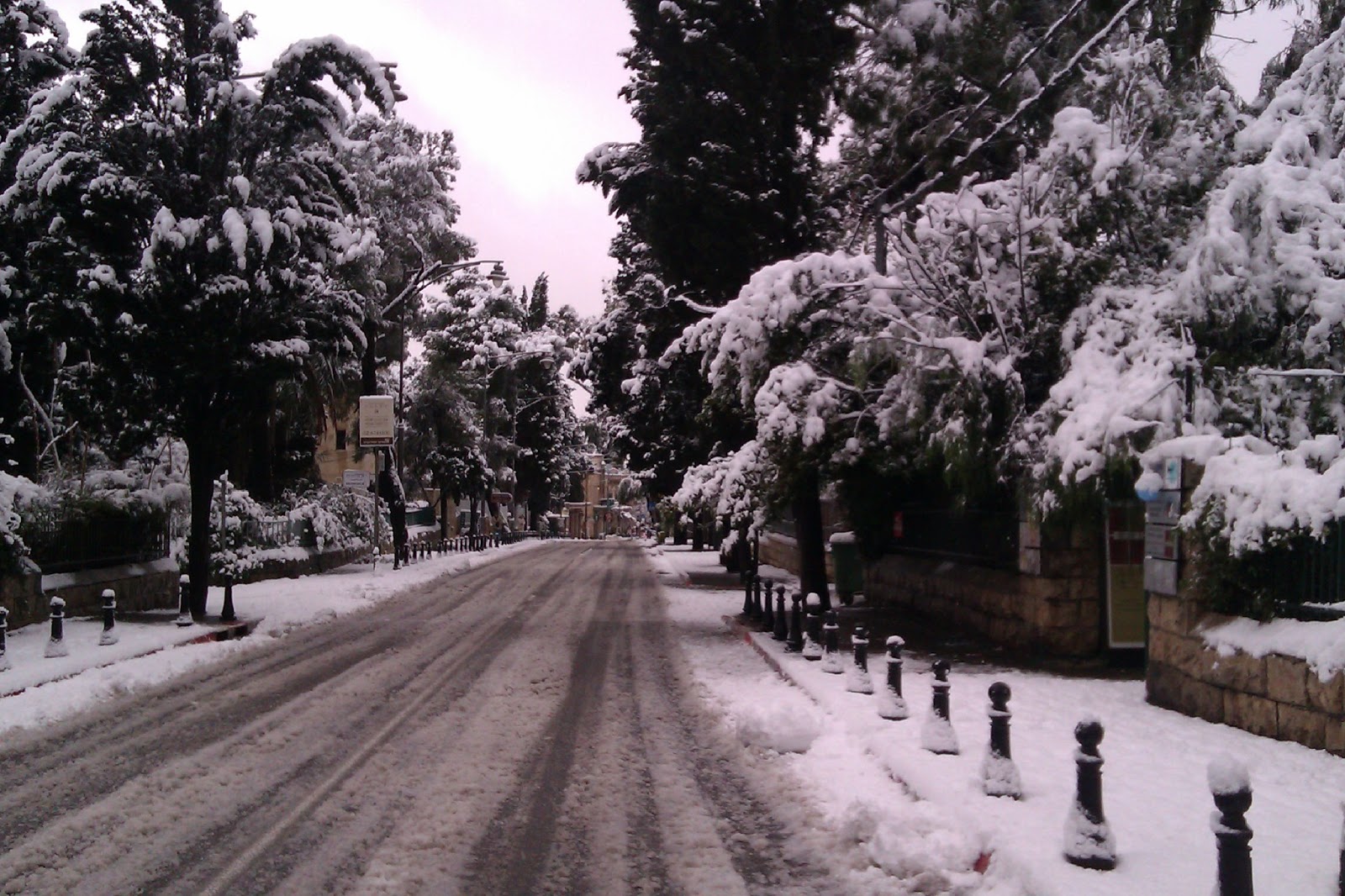
We did indeed get an impressive amount of snow overnight on Wednesday about 15cm.  Thursday morning Jerusalem was a winter wonderland. I spent two hours walking around enjoying it. Here are some highlights. First, from my neighbourhood:


Snow in my backyard at 730 am (10.01.13)


Snow!

Emek Refaim looking south -- no traffic!

Just one of the many snow-laden trees in town


My bus stop, in the snow

Emek Refaim -- peaceful! I love snow!


HaMoshava HaGermanit (10.01.13)


 Then we wandered into the Old City:


South wall of the Old City near Zion Gate

Looking southeast (toward the Dead Sea) from near Zion Gate

Theresa in the Old City...with falling snow
The Western Wall and Al Aqsa in snow


The Dome of the Rock in the snow

To get to the train station (which is oddly in the south of town) we had to walk, since there were no buses running until well into the afternoon. In a way it was an epic walk to escape Jerusalem, a city under siege of a snowfall. But, we weren't actually trying to escape because of the snowfall. About 6 weeks ago we planned this weekend trip to Amit's kibbutz to visit his family and tour the region a bit. It just so happened that our weekend away coincided with this crazy snowstorm.

Theresa

lots of folks were making snowmen

Amit leading us down Aza Street


Finally, here's what's left -- 3 days later -- in my backyard.


Around the city piles of snow remain. Things have warmed up a bit and the sun is out, but the indoor temperatures remain chilly. I'm still sitting in my office in my down sweater jacket. The infrastructure is just not built for winter --- or anything resembling it. The forecast is for 10 days of sun before our next wallop of winter.