Friday, May 10, 2013

Fruit of the month -- Shesek

The official start of summer in Israel is marked by the opening of a steady parade of fresh fruit, many of which I've never met. A good friend of mine here, Amit, is an intrepid fruit hunter-gatherer both at the market and in the neighbourhood and a walking encyclopedia of fruit so I'm getting acquainted with new fruits regularly.

This post is dedicated to the fruit known in Israel as the Shesek. You might know it as the Loquat. Or you  might not know it at all, like I didn't know it until about two weeks ago.

A sheshek tree:

A sheshek tree on Hovevei Zion


A shesek on my dessert plate

Shesek trees grow all around Jerusalem, this specimen was taken from a neighbourhood tree on a walk home from the movies. A shesek is about the size of an apricot (by volume) and shaped like a pear; this one had a bit of furry outside (like a peach). It has giant seeds that are about the size of a really round almond. This shesek had only two seeds, but seed number is variable from 1 to 6 (or so).


A shesek cut in half

A shesek seed, 1 of a pair

Biting into a shesek, the chewy skin gives way to a juicy, tender fruit that starts tangy-sour and finishes sweet.  Really yummy and highly recommended! Just don't bite into the seeds since they are rock hard.

A little Linnaeus (cause I'm still a botany geek) before I close. It should come as no surprise that the shesek is in Rosaceae (the rose family -- the home of many delectable fruits including apples, berries, peaches, almonds!). The shesek (or loquat, nispero, the Japanese plum, the Chinese plum, or pipa) is, in Latin, called Eriobotrya japonica. The pipa is native to (southeastern) China, but now cultivated widely in subtropical to mild temperate climates - Hello Israel! 

[Post prepared with help from Wikipedia! What was life like before Wikipedia?]


Saturday, May 4, 2013

Masada & Qumran & St. George's Monastery

Way back in January...

The day after we went to Beit Guvrin, we (Amit, Thomas, Theresa, Marisa, and I) went to Masada and Qumran and St. George's Monastery.  After an early start -- we had everyone in the car by 8am -- we headed east into the West Bank and down, down, down to the Dead Sea.

(Photo credits: TT)
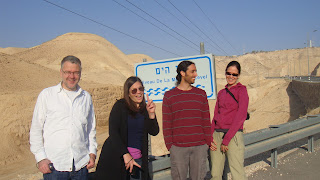
At sea level on the descent to the Dead Sea


Our first stop was at the southwest shore of the Dead Sea, in Israel: Masada.

Masada

Masada is an ancient hilltop fortress;  Herod the Great build a castle here in the 1st century BCE. The drama happened from 66-70 CE when the Romans were quashing the Jewish Revolt.  A thousand or so Jewish holdouts (some say zealots) refused to accept Roman rule. They retreated from Jerusalem to Masada and withstood the Roman attack for some months (maybe up to 4 years). When it became clear that the Romans had breached the entrance to the fortress the Jews committed group suicide (someone killed someone else until the last guy committed suicide). The legionnaires scaled the plateau to find it deathly quiet.

 The archaeological excavations make Masada an amazing place to visit. You can get a good sense of how life on the plateau was organized, and you can see where the Roman troops camped out.  We hiked up the snake trail (up the east side of the mountain) and took the cable car down.


Up the snake path

a break on the climb

nearly there

In Herod's time the fortress included a swimming pool, a quarry, a commandant's residence, storerooms, a bathhouse, officers' quarters, a synagogue, a guardroom, an administration building, and a complex water cistern system. Later the Byzantines occupied the fortress and constructed a church and a monastery.

buildings on top

model of Masada


half excavated half reconstructed


side view of the fortress walking to the northern palace


Views from the top:

view to the Dead Sea

wadi near Masada

the parking lot on the west side of Masada

TT, CC, AT

After leaving Masada we stopped a bit north at Ein Gedi for lunch at a picnic bench near the Dead Sea. (We didn't stop for a swim or float this time.)

Qumran

To get to Qumran you drive north on Hwy 90 back through the checkpoint and into the West Bank. Qumran is located near the northwest shore of the Dead Sea; it's dry and rocky like Masada. We quickly checked out the museum -- the cheesy video at the entrance was a bit off-putting. There isn't much to see at Qumran. Jewish settlement dates to the 8th century BCE, but what really makes it famous is that the Essenes, a break-away Jewish sect, lived there for two centuries -- somewhere between 150 BCE until 68 CE when they were conquered by the Romans during the Jewish Revolt.

Fast forward nearly 2000 years.

In 1947 (these dates according to the Israel Nature and Parks Authority pamphlet), seven scrolls were found by Bedouin shepherds -- legend says they were looking for a lost sheep. (This is believable as we did a short hike up behind the museum into the hills; the terrain is tremendously rugged and there are endless caves that a wayward sheep could explore.)  Shortly after the scrolls were found, French archaeologists began excavations in the area. Cutting what must have been a long story short, viola! the French found more scrolls and determined this must have been the site of the Essene settlement.

So what?

Well, these scrolls are the very Dead Sea Scrolls that are on display at the Shrine of the Book at the Israel Museum in Jerusalem. Turns out the Essenes were committed scribes (and ascetics) and they transcribed books of the Old Testament, the Apocrypha, and some of their own sect's works. They stored the rolled scrolls in jars that they tucked into the crevices and caves of Qumran: An ancient library!


view down the wadi, east to the Dead Sea

hiking up

a cave where a scroll might have been
Shrine of the book -- where the scrolls are now


coming down

St George Monastery 

Turning west off of hwy 90 onto hwy 1 and climbing back above sea level we turned north and switched religions. Wending our way down a road that seemed to go nowhere, but provided great views, we found the car park and path to Wadi Qelt. The Lonely Planet describes Wadi Qelt as a naturalist's treat. Indeed it is. And, St. George's Monastery is a spectacular 5th century structure built into the rock face. We arrived too late for a tour inside the Monastery, but the hike down to the wadi was fantastic. There are rare sightings of flowing surface water in Israel, and this one was a delight. There are remnants of old Roman aqueducts and the greenery is lovely...and best of all is the sound of running water!

looking into Wadi Qelt

St. George's Monastery

St. George's Monastery

greenery in the wadi

TT, CC, ML, AT

Then we hiked up out of the wadi, piled into the car and drove back to Jerusalem. We were exhausted from our very successful touristic weekend.


Friday, May 3, 2013

Footie and Politics

Today I attended the final game of the season of Hapoel Katamon Jerusalem. They play at Teddy Stadium in Jerusalem (in Malha, near the train station). My Israeli family are huge fans of Hapoel Katamon -- the only fan-owned team (like Barcelona) in Israel. Hapoel Katamon has played in the third league in Israel since the team was created in 2007. By winning today's final by a sufficient margin (9-1, it was a stinker, the other team barely made it to the pitch, last night it wasn't clear the game was going to happen) the team has secured a promotion to the second league next season. Very exciting!

So here's the stadium...the pictures won't show you that we lined up, well, you know, queued Israeli-styles to try to get a drink at halftime. Okay, Sivan did, I hung back out of the masses. But, no luck - they were all out of drinks. The only thing they seemed to be serving was Coca-Cola from the 2L bottle, no beer available! (As a veteran concession stand worker from my days at Swangard this confounded me. Both that you would pour from a 2L and not push from a fountain and that you could run out of drinks!)

Teddy Stadium -- everyone sits on the shady side!

play on the field, kippa on some men
And pix of some fans...We were sitting standing in the "hardcore fan" section. On our feet the entire time and singing (or in my case, humming) along to the team songs. Oddly, to me, the fans continue to sing while play is on -- continuously. It's a young team, but they have songs enough you'd think they'd been around for 50 years. And everyone knows the songs.

the rowdy section
There is another unique feature to Hapoel Katamon, besides the fan ownership. Fans of Hapoel Katamon include women and children. And, when you go to a game, kids and women (including a safta or two (grandmas)) are even in the crowd. Apparently, most other football games in Israel are characterized by violence -- very aggressive events. I don't have first hand knowledge of this, today was my first footie game in Israel.

It was good fun, that might have been great had the game not been such a rout.

Hapoel Katamon scores, again!

Still celebrating
At the end of the game the fans sing a duet with the players -- it's actually really cool. They clearly adore each other.

My ticket to the match


So, where's the politics? Well, Hapoel Katamon (a neighbourhood in Jerusalem) was created because fans were unhappy with Hapoel Jerusalem. Originally, Hapoel Jerusalem was owned by Israel's organization of workers' unions and stood for socialist values. Their archrival was Beitar Jerusalem -- a team that was (and still is) associated with the right wing. Hapoel Jerusalem fans were disappointed and frustrated with the ownership's antics (not to mention the team's performance) so they bailed and bought into Hapoel Katamon...with hopes that HK will displace HJ sometime soon. Today's victory was a huge step in the right direction.

Sunday, April 28, 2013

While you were away...

Back in Israel, summer has arrived. The daytime highs are pushing at 30C and I cannot say I mind. After a chilly and wet bit of spring in Vancouver, I'm quite enjoying drying out and warming up!

While I was away, the holidays were coming fast and furious in Israel. As you may recall, I left Israel the first night of Pesach. About two weeks of holiday follow on Pesach...university is closed, Jews from around the world visit Israel, Passover being one of the pilgrimage holidays in the Jewish calendar. Between Passover and Shavuot (Pentecost) is a period of semi-mourning in the Jewish calendar. From Wikipedia (ah, wikipedia, what did we do before you?):

The 49 days of the Omer [counting from the first night of Passover] correspond both to the time between physical emancipation from Egypt and the spiritual liberation of the giving of the Torah at the foot of Mount Sinai on Shavuot [7 weeks, 49 days after Passover], as well as the time between the barley harvest and the wheat harvest in ancient Israel.
In this stretch of 7 weeks there are several holidays, but few of them are joyful. Three of them occurred while I was in Canada:

Holocaust Remembrance Day (Yom HaSho'ah) 7-8 April 2013 (sunset to sunset)
This is self-explanatory: It's a day to remember the six million Jews that died in the Holocaust. Across the country at 10am sirens sound and Israelis stand silently at attention.
I am sorry to have missed this day because of its solemnity and also because seeing Israelis stand still and silent would be an amazing thing.

Memorial Day (Yom HaZikaron) 14-15 April 2013
This is less obvious. It's a day to commemorate the soldiers who fell defending Israel and the victims of terrorism. The sirens sound at 8pm and 11am and again, Israelis stand silently at attention wherever they may be. This day I'd really like to have seen as it offers the benefit of seeing a normally very active culture stop and stand still, but it also highlights divisions in Israeli society--not everyone wants to celebrate this day. I've been told that when the sirens sound the Haredim and Arabs don't stop, but keep going about their day.

Israel Independence Day (Yom Ha'Atzma'ut) 16 April 2013
Celebrates Israel's declaration of independence in 1948.

And then last night was the fourth holiday...considered a break in the mourning period.

Bonfire Day - Lag BaOmer 27-28 April 2013
Most Israelis I've asked about this day are a bit fuzzy on its meaning. Something to do with commemoration of the fall of the 2nd temple and something to do with the kabbalah. Today it is mostly a children's holiday: A chance to build a bonfire and roast marshmallows and potatoes and stay up late. Lag BaOmer is the 33rd day between Passover and Pentecost, so it should only be one night, but this year it's being celebrated two nights in a row (something about shifting it because yesterday was shabbat). I have no idea about any of this but I can report that the air quality is not improving tonight. I walked home along a road with a park on one side of it (Dor Dor Vedorshev) and the park slope was blanketed in bonfires. Smokey the Bear would be appalled -- it's awfully dry out there, the humidity is about 10% right now (we have a heat wave -- Red Sea Trough -- which thankfully doesn't have high winds) and the daytime highs are 30C. Yikes!

Meanwhile, I'm settling back into life here. It's good to be back and I look forward to getting caught up on my postings (and work)!

Sunday, April 21, 2013

Packing up

Greetings!

Since the trip to LA, I have been busy in Vancouver -- seeing friends and family, running errands, and helping out with some housepainting! Egad...where does the time go?


I've been to Granville Island, where I walked a bit of the seawall

Looking up False Creek
and, I listened to my favourite busker at Granville Island (coincidence)

Le chanteur francais

while avoiding the curious fellow that feeds the pigeons from his lap (um...maybe he could do that where folks aren't trying to eat their lunch?).

I've been to UBC campus...
On theme: UBC's Hillel House (the home of Jewish life on campus)

I've walked Jericho Beach to Spanish Banks. I've been to the Apple Store at Pacific Centre Mall, where the "genius" dude did me the favour of blowing the dust out of my keyboard...my MBA is almost like new.

The big news in BC is that the writ for the provincial election has been dropped and the parties - there are two contenders to form the government, the Liberals and the NDP - are hard on the trail, voting is May 14.

And, although there's been plenty of rain and it's been quite cool, it's always easy to admire the glorious cherry trees in Vancouver when just a bit of sunshine graces the grey lower mainland.
 
Cherry blossoms on Yew Street

Thanks for your patience with my irregular posting this month. I'll be back in Israel next week where I look forward to blogging more regularly.

Thursday, April 11, 2013

Life in NA

It seems the pace of life in North America is fast. I feel like I've been running since I stepped of the plane at YVR. I have managed to attend to several errands and see lots of folks (if you are in Vancouver and haven't seen or heard from me, it's not because I haven't thought of you, it's that I cannot drink that much coffee!).

I've managed to spend time on my bike and on my skis. Skiing on the last weekend of the season at Hollyburn was amazing -- great weather, good snow, and an egg unit at the lodge to wrap it all up. I'm not exactly in "end of season" form, but my ski buddy still let me set the pace (thanks Jane!).


The blogger on skis

Now I'm in LA attending the Association of American Geographers Annual Conference -- a bizarre event where some 8000 academics gather for 5 days to discuss all sorts of things under the broad umbrella of 'geography'. There are physical geographers - those that study rivers and map stuff - and human geographers - those that study things like political economy, representations of the state, and the political geographies of waste.  I've been to some great and not-so-great presentations, but the highlight is definitely seeing good friends that are now scattered across the continent (or world).

These trips rarely afford much time for sightseeing but I did go to see the Frank Gehry-designed Disney Hall -- a walk by since I couldn't stay for a tour.  And, I've seen the Westin Bonaventure, the Biltmore Hotel, the LA Hotel, and the LA Public Library. A weak showing when downtown LA really deserves more time!

Must run, off to another session here.

Tuesday, April 2, 2013

Easter and buses

Greetings from Vancouver. After a long, but uneventful trip (which included a great ride in the Nesher sherut to the airport: great because the Nesher driver was polite, didn't smoke and didn't scream at anyone!) I arrived in Vancouver.  So far it's been nonstop visiting -- catching up with friends and family and eating all my favourite Vannie foods (xiao long bao topping the list), not to mention Easter turkey.  I'm having a great time. (The sun and cherry blossoms are also amazing!)

On Thursday I was riding the bus and train to midtown to meet friends for coffee and lunch.  Events on the bus gave me a chance to compare life here and there.  In Jerusalem the buses are frequently packed. And, I mean packed: there is no space left for anyone to squish anywhere. Here are a couple of examples:


On the bus to Mt Scopus (No. 19)

On the bus (No 19)
 
And, here's how you get on:
Loading the bus from Mt. Scopus
Israelis don't line up for the bus, at least not in the way your average Anglo-Saxon mannered North American would. The queue isn't long and skinny, it's short and fat and functions more like a funnel. You learn that coming in at the side of the line works as well as, or better than, going to the back of the line. And, you learn to take up space, subtly, but solidly so as to secure your entry to the bus. (I learned this  last October by missing 2 buses in a row and finally 'winging' my way into the 3rd.)

Anyway, none of these new manners are really necessary in Vancouver. People mostly queue in the long skinny sense. But, more importantly, and more comically to me on Thursday, the bus won't ever be filled to its physical capacity (as distinguished from its assigned capacity) in Vancouver.  The driver announced that if anyone couldn't get behind the red line they'd have to get off the bus! The red line marks off the space of the front of the bus that gives the driver clear sight lines. In Jerusalem, the driver often pulls away from the stop when 3 or 4 people are standing in the door (you have to squeeze in to be sure to not get caught in the closing doors) and proceeds to process payment (you can still get change on the bus in Jerusalem) while he drives down the road navigating traffic.