- Hot water is not necessarily available on demand. If you have a solar panel then you will have hot water on demand about 8 months of the year. Otherwise you had better have patience (or a timer) because it takes about an hour for the boiler to warm the water sufficiently on a cold and cloudy winter day.
- Many households do not have clothes dryers. In the summer this is no problem, you can be sure your clothes will dry within the day inside, faster outside. In the winter, when the rain might be incessant for nearly a week this can be a problem. Plan ahead if you need a particular outfit in your small wardrobe!
- A Haredi man may put his hat in front of his face, or look away, for the duration of the time that you (a female) are in his line of vision - walking by on the street or standing on the bus.
- Be aware of where you sit on the bus; the last empty seat which is next to a Haredi man might not be a good choice. I've never tried it because I don't want the conflict but there have been serious conflicts in Israel over segregated buses - men in the front, women in the back. Women don't sit next to religious men.
- The cost of consumer goods varies by neighbourhood. For example, 500mL bottle of water costs NIS 5 in most of West Jerusalem and NIS 3 in East Jerusalem. A meal of hummus also costs more on the west side.
- Sidewalks are not just for pedestrians and cats and dogs. They are also for riding bikes, erecting sukkot (the shelters for the upcoming holiday), and parking cars.

Metal bars on sidewalk so that cars parking across the street don't back over the sidewalk

Pedestrian funnel

Um?

Weave!
Should you find yourself with a free, relatively smooth patch of sidewalk be ready to duck, bob, and weave at any moment -- the plants overhanging could knock you out. The City repaved considerable tarmac this summer, maybe they ran out of money for trimming back overgrowth on sidewalks? Maybe it's like this every year? Maybe there is no sidewalk municipal liability here?
Time to trim your hedge!

Duck!
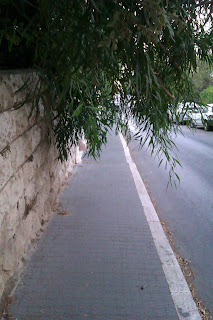
Jungle Jerusalem
- If you plan to swim at the community pool confirm the day and hour you've chosen are gender appropriate. Pools have male, female, and mixed sessions. So do yoga and pilates classes.
- Shopping at the drugstore is never fast and it's the kind of experience that belongs in a comedy sketch. Nothing is organized in a way that anyone can find. Each time I go to the SuperPharm there is at least one item I cannot find. Asking for help results in a clerk dragging me around the store in circles and ultimately telling me they don't know where the item I asked for is. I thought this was an experience unique to nonHebrew speakers - it is not.
- Drinking coffee is a daily (or multiple times daily) social activity here. The standard order is a cafe hafooch (or hafuch?) which is meant to be a cap, but usually comes out as a latte. At home many people make Turkish coffee (yum cardamon) by pouring boiling water on the grains and letting it settle. Admittedly, this is better than instant coffee, but it isn't as good as a true boiled Turkish coffee. In sum, the coffee isn't all that good, but no matter, social life revolves around it.
- Hummus is an institution in Israel. Seriously. People argue over where to go for hummus because they
disagree on which place makes it best. To appreciate this you need to
know that people are not arguing over that small plastic container of
yellow-beige goo that you bought at Whole Paycheque and intend to
slather on your rice crackers. They are arguing over bowls of warm
chickpeas pureed with tahina, lemon, and olive oil, topped with more
chickpeas, or "fool" (fava beans - awesome), fried mushrooms, or ground
beef (not so much) and served with fresh and warm pita.
Critical is the side dish of pickles and onions - and here, I have to tell you - eat the raw onions. I never eat raw onions, but with the hummus, well, just do it. And, a Coke or a beer on the side to wash it all down. Yum! My favourite place to eat hummus is in a cave of a restaurant in the Old City on Fabric Street about halfway to Damascus Gate from the Western Wall. Food made by Arabs, patronized by everyone. On certain days they serve Makloubah (Arabic for upside down) a dish of rice, potatoes, eggplant, onions, nuts and sometimes meat. Also amazing.
A giant lunch: pita, pickles and onions, small hummus and kubba soup - Olive Oil. Yum! The stuff you buy at the supermarket has a taste and 500mL of it sells for $7.
- Falafel - Chickpeas, again! This time ground up into little balls, deep fried, stuck into a laffah (shaped like a tortilla, but spongy: so yummy) or a pita (makes a smaller size sandwich that has a higher bread to filling ratio), surrounded by salads -- cucumber, tomato, cabbage, raw onions, slathered with tahina and topped with soggy, greasy fries if you want.
- Business opportunity -- There is no Mexican food to be found. Devastating. Some days you just want a black bean instead of a garbanzo bean.
- Sabih - This is the Middle Eastern answer to the BLT. Built like a falafel on laffah or pita, filled with salads, fried eggplant and slices of boiled egg topped with tahina, and fries if you want. Surprisingly delightful.
- Fruit - you know how I feel about the fruit here - Amazing!
- Carob juice - a seasonal treat to be found in the Old City. Looks like flat cola, tastes like sweet carob. Sold in 250mL cups, you really only need about a tablespoon for the experience.
- Building - house or apartment - renovations seem to involve endless jackhammering and I have not figured out why.
- Music. Israel is an amazing place for music. The Hebrew U includes a Music Academy of excellent quality. I've seen several spectacular student performances. The Jerusalem Theatre has a full calendar - almost nightly - of concerts (usually classical) including a weekly free concert that is very good. The live jazz scene is fantastic, especially in Tel Aviv. And, other genres and fusions are well represented at the Yellow Submarine in Jerusalem. Frequently you don't need to pay cover; sometimes a hat gets passed around.
- Wine. You may be surprised to learn that Israel has some excellent wine. My favourite is Pelter after a tour of their facilities and a great wine tasting last winter. I particularly love their Cabernet Franc, but my budget doesn't!
And, they have amazing goat's cheese. Alas, even wine is political. Pelter is grown in the Golan which is contested territory.
Pelter cork as gnu - In an earlier post I said that Gaza doesn't have many sites to lure an average tourist. That's not quite accurate. Gaza has many interesting historic sites and fantastic Byzantine mosaics. An archaeologist is quoted in a Ha'aretz story saying Gaza 'was once a "very rich oasis, with gardens, cities and you have settlements, dwellings, fortresses, cities everywhere, everywhere."' This makes sense - Gaza is along the coastal route from Egypt to the Levant. But, the politics of Gaza mean that archaeological preservation and exhibition isn't a priority right now.
- When making tea, after the water boils wait. Wait for the mineral deposits to settle before you pour the water. And, don't drink to the bottom of your cup, there are more deposits there. You'll know you've reached them when you get that sandy feeling in your mouth.
Sunday, August 25, 2013
Random notes on life in Jerusalem


Saturday, August 24, 2013
Queuing like a Sabra
As I've mentioned before, riding public transit in Jerusalem is a bit of a sport characterized by buses that are often not on schedule, gridlocked traffic, standing room only, and crazy filter-like queues. Importantly, this style of queuing is not restricted to public transit, it's just how Israelis - Sabras those born here - queue. When it really matters that things happen in a more controlled manner, there are systems in place -- you take a number (from one of those red plastic things on the wall that are shaped like a 9), you write your name on a list (although in my experience from getting a RavKav the number and name systems quickly break down), or you are funnelled through metal rails (they have these at the central bus station, but the filter queue emerges when you pass through the terminal to the bus garage). It's just how you queue in Israel, more on why that might be later.
Here's a graphic of the difference in queuing styles:

I know, you are thinking that the shape of the Israeli queue makes no sense. Here, I would suggest that you are thinking like the rest of the NHL in the very early 1980s. The Edmonton Oilers, and No.99 specifically, would tell you that you are neglecting an important zone of play -- behind the net. Why can't you queue from in front of the bus?
Jerusalem has an LRT that started operating in early 2012. The LRT runs from Mt. Herzl in the west through the City Centre, down Jafo Rd, past the City Hall, the Old City, up Road No.1 and deep into East Jerusalem (yes, very curious - an LRT that connects a contested city). As with the installation of all LRTs, numerous bus routes were taken away, thus the LRT has a huge ridership. And, as most riders of light rail know it's no delight to try to get off the train when a mob of people trying to get on crowds the door. Sabra-style queuing results in mobs at the train doors all the time and it's pretty unpleasant.
So, imagine my surprise when at the train station at Ammunition Hill in May, I noticed that the LRT Authority had mounted a campaign to get Israelis to queue differently, to queue like I know how to queue. Here's a poster that can be found at each station showing how if you are boarding you need to stand aside and wait for passengers to exit the train.
And, helpfully (heehee), lines have been painted at each train stop to show you where to stand to effect this efficient queuing style.
I have to admit to laughing out loud at this campaign. Breaking Sabra queuing styles is going to take more than a passive campaign - Israelis approach rules as advisory. Sorta like "thanks for your suggestion, but I'm going to do it my way." It's that attitude that is credited with the strength and innovative success of the Start Up Nation. Every Israeli has an opinion and no one is going to be played as the fool. Only fools follow rules and get caught out on getting what they need because they did as they were told.
Where does this attitude come from? Well, it seems to be partly attributed to the history of the Jewish people, and partly to how it was in the early days in Israel. Immigrants flooding into pre-state or nascent Israel had hard lives -- there was little money and limited food. People recognized that they would have to look after themselves and acted accordingly. The culture that emerged created the Sabra (a prickly pear) -- an Israeli-born Jew -- who is prickly on the outside, but soft and sweet on the inside. Indeed, Israelis have told me that they are "obnoxious" -- a not untrue statement. Equally, you are unlikely to find a group of people who, once they've had a conversation with you, will be so warm and welcoming - inviting you to a meal at their home, helping you manage any number of quotidian activities, and generally looking out for you.
That's the thing about Sabra style-queuing, it may seem obnoxious, but it's almost always obvious that people's intention is not to cut you off, but rather to make sure they get their place. It took me a while to understand that having grown up in a place where someone acting like a Sabra, flouting the rules, would quickly be labelled as more than obnoxious.
Here's a graphic of the difference in queuing styles:

Jerusalem has an LRT that started operating in early 2012. The LRT runs from Mt. Herzl in the west through the City Centre, down Jafo Rd, past the City Hall, the Old City, up Road No.1 and deep into East Jerusalem (yes, very curious - an LRT that connects a contested city). As with the installation of all LRTs, numerous bus routes were taken away, thus the LRT has a huge ridership. And, as most riders of light rail know it's no delight to try to get off the train when a mob of people trying to get on crowds the door. Sabra-style queuing results in mobs at the train doors all the time and it's pretty unpleasant.
So, imagine my surprise when at the train station at Ammunition Hill in May, I noticed that the LRT Authority had mounted a campaign to get Israelis to queue differently, to queue like I know how to queue. Here's a poster that can be found at each station showing how if you are boarding you need to stand aside and wait for passengers to exit the train.
 |
| How to queue |
 |
| No, the other arrow |
I have to admit to laughing out loud at this campaign. Breaking Sabra queuing styles is going to take more than a passive campaign - Israelis approach rules as advisory. Sorta like "thanks for your suggestion, but I'm going to do it my way." It's that attitude that is credited with the strength and innovative success of the Start Up Nation. Every Israeli has an opinion and no one is going to be played as the fool. Only fools follow rules and get caught out on getting what they need because they did as they were told.
Where does this attitude come from? Well, it seems to be partly attributed to the history of the Jewish people, and partly to how it was in the early days in Israel. Immigrants flooding into pre-state or nascent Israel had hard lives -- there was little money and limited food. People recognized that they would have to look after themselves and acted accordingly. The culture that emerged created the Sabra (a prickly pear) -- an Israeli-born Jew -- who is prickly on the outside, but soft and sweet on the inside. Indeed, Israelis have told me that they are "obnoxious" -- a not untrue statement. Equally, you are unlikely to find a group of people who, once they've had a conversation with you, will be so warm and welcoming - inviting you to a meal at their home, helping you manage any number of quotidian activities, and generally looking out for you.
That's the thing about Sabra style-queuing, it may seem obnoxious, but it's almost always obvious that people's intention is not to cut you off, but rather to make sure they get their place. It took me a while to understand that having grown up in a place where someone acting like a Sabra, flouting the rules, would quickly be labelled as more than obnoxious.
Friday, August 23, 2013
Judah the Lion and his cousins
Those of you well acquainted with the Bible will know that the Lion is the symbol of Judah (4th son of Jacob the Israelite) -- see Genesis and Revelations. Or, you may know the lion appears frequently in Jewish art. At one point (like so many other species!) lions did live in the
Middle East - actually their range extended out of Africa north to
Europe and east to India. They were extinguished from Palestine before
the 1400s (according to, yes, Wikipedia!).
In 1950, the Israeli part of Jerusalem adopted as its official symbol the lion to represent and remind Jewish people of their heritage. Here's the municipal "logo" - the Hebrew letters read Yerushalayim - Jerusalem.

You can find the lion symbol on anything the City does (of course) including trail markers, and at the centre of a water fountain at Bloomfield Park that was a gift from the German people (and that I can't find my photo of).
When it comes to felines in the flesh, though, about all Jerusalem can offer these days is cats. Lots and lots of cats. I've been told that there are so many cats in Jerusalem because during the Mandate, the Brits brought them in to manage an exploding rat population. This could be an urban myth, but there really are hoards of cats here.
At the university they can be found everywhere in the gardens (sorta like rabbits used to be at UVic), and if you dare to eat outside (which obviously you do frequently because of the climate), you have to be on guard for your meal or at least tolerate a good amount of attention from the four-legged furry lunch patrol. It's as if they are constantly asking, "Hey, you gonna finish that?" They also come inside the uni and cruise the coffee shop hoping for treats and generally looking to be adopted. Most folks who have cats have more than two. They've adopted them off the street and had them dewormed and spayed/neutered (typically evidenced by a clipped ear or a collar). It's a tough life for cats that don't get adopted -- competition is stiff for food and even if you've staked out good territory you could get caught in a drought. For example, if you are cat that lives at the university, you will probably do well enough from mid-October until late July; August and September are lean months when few people are on campus. And, if you don't have a collar or a clipped ear, you are subject to the semi-annual feline roundup that the city conducts.
In 1950, the Israeli part of Jerusalem adopted as its official symbol the lion to represent and remind Jewish people of their heritage. Here's the municipal "logo" - the Hebrew letters read Yerushalayim - Jerusalem.

You can find the lion symbol on anything the City does (of course) including trail markers, and at the centre of a water fountain at Bloomfield Park that was a gift from the German people (and that I can't find my photo of).
When it comes to felines in the flesh, though, about all Jerusalem can offer these days is cats. Lots and lots of cats. I've been told that there are so many cats in Jerusalem because during the Mandate, the Brits brought them in to manage an exploding rat population. This could be an urban myth, but there really are hoards of cats here.
At the university they can be found everywhere in the gardens (sorta like rabbits used to be at UVic), and if you dare to eat outside (which obviously you do frequently because of the climate), you have to be on guard for your meal or at least tolerate a good amount of attention from the four-legged furry lunch patrol. It's as if they are constantly asking, "Hey, you gonna finish that?" They also come inside the uni and cruise the coffee shop hoping for treats and generally looking to be adopted. Most folks who have cats have more than two. They've adopted them off the street and had them dewormed and spayed/neutered (typically evidenced by a clipped ear or a collar). It's a tough life for cats that don't get adopted -- competition is stiff for food and even if you've staked out good territory you could get caught in a drought. For example, if you are cat that lives at the university, you will probably do well enough from mid-October until late July; August and September are lean months when few people are on campus. And, if you don't have a collar or a clipped ear, you are subject to the semi-annual feline roundup that the city conducts.
 |
| Shabbat afternoon...when's dinner? |
 |
| A cat I lived with - Shelag (Snow) |
 |
| Coffee shop busker |
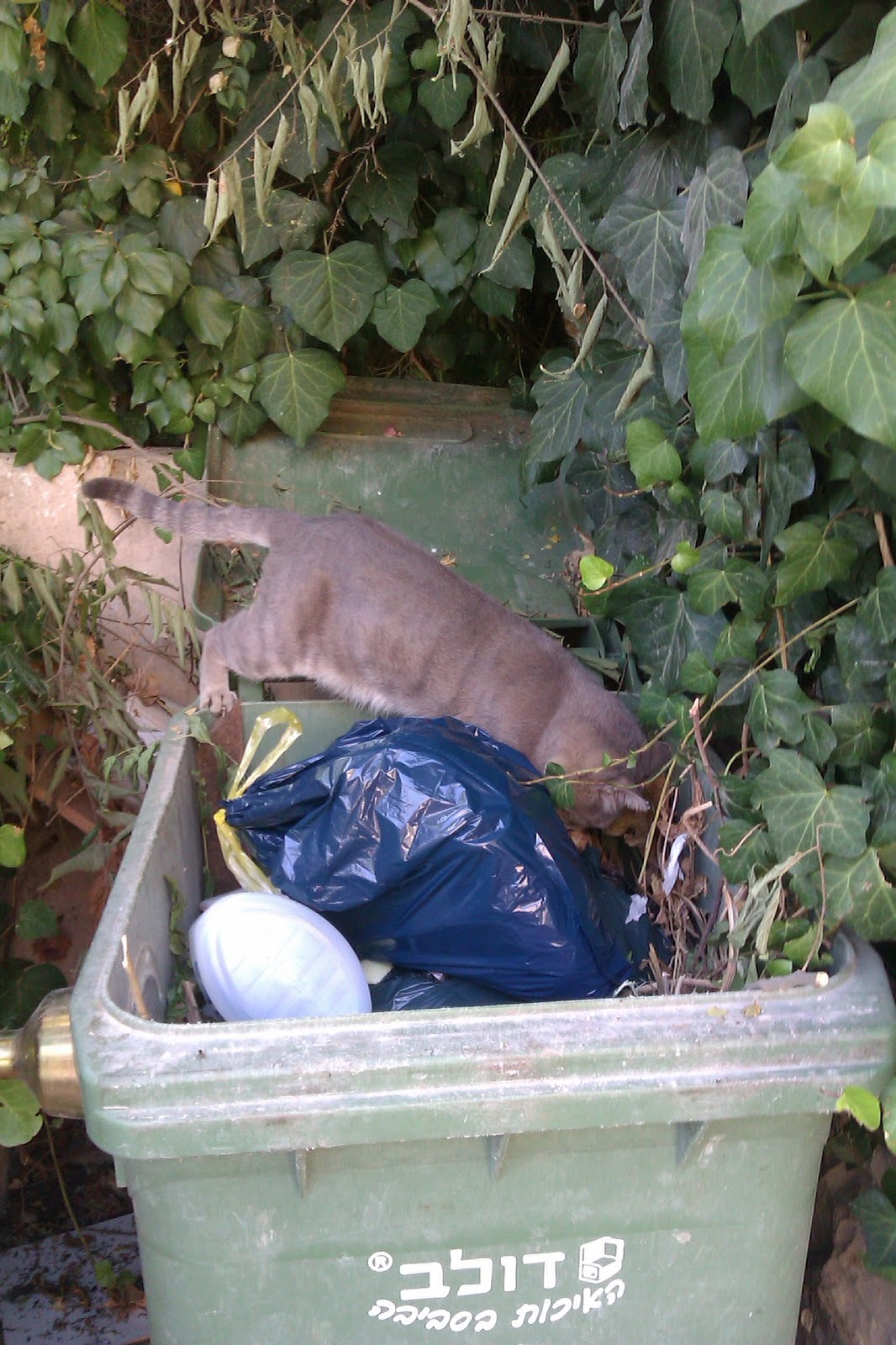 |
| Neighbourhood binner |
 |
| In the plant pot |
 |
| Breakfast? |
Sunday, August 18, 2013
Shabbat dinner
Lately I've been reflecting on my favourite things about life in Israel. Near the top of my list is Shabbat dinner.
I grew up in a pretty areligious home. We celebrated Christmas and Easter, but outside of weddings and funerals I can count on one hand the number of times I've been to church with my parents. Although we didn't go to church and I never went to Sunday school, we did always have family Sunday night dinners. My maternal grandparents joined us occasionally; my paternal grandparents came to dinner (based around a roast of beef) nearly ever Sunday night in the winter when they were in residence (i.e. not on vacay). In the summer we were more likely to go to them at the cottage.
As an adult, I've been known to head to mom and dad's for a well-balanced (and well cooked! my parents are great cooks) sustaining meal on Sunday nights. But, this is Sunday night; the night before the work week starts again. In Israel, the family meal is Friday night after sundown whether you are secular or religious. The work week starts on Sunday, so Friday night is the middle night of your weekend (Saturday night for Westerners). After dinner, if you are secular or traditional, you might head out on the town with your friends, meeting them at the bar by 11pm or so. If you are conservative or more religious, you probably hit the couch and chat or read before heading to bed. You don't do dishes until Saturday after three stars are seen.
I am hard pressed to think of anyone in my acquaintance in North America who would consider going home for dinner in the middle of the weekend. Partly, this is because many of us live miles away from our parents. Thus, going home for dinner is often part of a weekend trip that is made a few times a year. In Israel (a notably smaller country!) everyone goes home for Shabbat dinner as often as possible. It's a standing date on the schedule and you work your social life around it. An obvious reason for this is proximity, but I'm not sure that's the only reason.
Anyway, why do I like shabbat dinner? Two reasons. First, because whether it's secular or religious (I've been to secular, traditional, conservative, and modern orthodox dinners), Shabbat dinner is characterized by some degree of ceremony. The ceremony may be seen in the type of food and courses served (often: salads, soup, fish, meat and vegetables, and then parve (kosher non dairy) dessert (not my favourite!)). Or it may be in the practice of kiddush over wine, and the blessing over the challah. There is always more food than the table could possibly finish (it will be eaten on Shabbat (all day Saturday) when Jews are not meant to cook). Shabbat doesn't just mark the end of the week, it reinforces a cultural (or cultural-religious) identity.
Second, I like the openness of discussion around the table. Not every table does this, but the best Shabbat dinners include a lively discussion on politics or ethics or football. Everyone has an opinion and shares it; disagreement is permitted and voices are usually raised! I'm not sure there are never hard feelings, but there does seem to be an ability to agree to disagree. Sitting at the Shabbat table I have learned much about Jewishness and Israeli society.
I grew up in a pretty areligious home. We celebrated Christmas and Easter, but outside of weddings and funerals I can count on one hand the number of times I've been to church with my parents. Although we didn't go to church and I never went to Sunday school, we did always have family Sunday night dinners. My maternal grandparents joined us occasionally; my paternal grandparents came to dinner (based around a roast of beef) nearly ever Sunday night in the winter when they were in residence (i.e. not on vacay). In the summer we were more likely to go to them at the cottage.
As an adult, I've been known to head to mom and dad's for a well-balanced (and well cooked! my parents are great cooks) sustaining meal on Sunday nights. But, this is Sunday night; the night before the work week starts again. In Israel, the family meal is Friday night after sundown whether you are secular or religious. The work week starts on Sunday, so Friday night is the middle night of your weekend (Saturday night for Westerners). After dinner, if you are secular or traditional, you might head out on the town with your friends, meeting them at the bar by 11pm or so. If you are conservative or more religious, you probably hit the couch and chat or read before heading to bed. You don't do dishes until Saturday after three stars are seen.
I am hard pressed to think of anyone in my acquaintance in North America who would consider going home for dinner in the middle of the weekend. Partly, this is because many of us live miles away from our parents. Thus, going home for dinner is often part of a weekend trip that is made a few times a year. In Israel (a notably smaller country!) everyone goes home for Shabbat dinner as often as possible. It's a standing date on the schedule and you work your social life around it. An obvious reason for this is proximity, but I'm not sure that's the only reason.
Anyway, why do I like shabbat dinner? Two reasons. First, because whether it's secular or religious (I've been to secular, traditional, conservative, and modern orthodox dinners), Shabbat dinner is characterized by some degree of ceremony. The ceremony may be seen in the type of food and courses served (often: salads, soup, fish, meat and vegetables, and then parve (kosher non dairy) dessert (not my favourite!)). Or it may be in the practice of kiddush over wine, and the blessing over the challah. There is always more food than the table could possibly finish (it will be eaten on Shabbat (all day Saturday) when Jews are not meant to cook). Shabbat doesn't just mark the end of the week, it reinforces a cultural (or cultural-religious) identity.
Second, I like the openness of discussion around the table. Not every table does this, but the best Shabbat dinners include a lively discussion on politics or ethics or football. Everyone has an opinion and shares it; disagreement is permitted and voices are usually raised! I'm not sure there are never hard feelings, but there does seem to be an ability to agree to disagree. Sitting at the Shabbat table I have learned much about Jewishness and Israeli society.
Sunday, August 11, 2013
Fruits of the month
So last month I missed a fruit posting, but not because there isn't any fruit! If you like fruit, Israel is an amazing place to be in the summer.
Here's a small plate of fruit:
Mangoes! Grapes! Lychees! Figs! Prickly Pears (aka cactus pears) (not pictured)!
Multiple varieties of many fruits are available at the Mahane Yehuda (the shuk). And some are available on your neighbourhood tree (especially figs).
Here's what Mahane Yehuda looks like on a Friday afternoon in the summer -- all the locals plus busloads of tourists:
Eating a lychee is a delicate sweet, perfume-y experience. There's only one species of lychees in the genus (Litchi chinensis in the soapberry family) -- the available varieties are cultivars.
And, now I'm out of lychees...
Here's a small plate of fruit:
 |
| Some fruit in August in Jerusalem |
Multiple varieties of many fruits are available at the Mahane Yehuda (the shuk). And some are available on your neighbourhood tree (especially figs).
Here's what Mahane Yehuda looks like on a Friday afternoon in the summer -- all the locals plus busloads of tourists:
 |
| Marketgoers! |
I had some Maya Mangoes last week that were sensational. This week's, not Maya, mangoes paled in comparison. Seriously, I might be becoming a mango snob.
Off of this week's fruit plate I think the lychee might be the most interesting fruit (it's definitely the most expensive!). If you've only ever eaten canned lychees, you won't recognize a fresh lychee. It's a reddish spiky acorn sized fruit.
 |
| Lychee half peeled |
If you peel a fresh lychee you'll see the flesh looks like flower petals grown over the pit.This is an aril, an outgrowth of the attachment point of the seed -- like the flesh of a pomegranate or mangosteen -- and is, in plant propagation strategies, intended to encourage some critter to eat it so as to ensure seed dispersal.
 |
| Peeled lychee - ready to eat |
Eating a lychee is a delicate sweet, perfume-y experience. There's only one species of lychees in the genus (Litchi chinensis in the soapberry family) -- the available varieties are cultivars.
And, now I'm out of lychees...
Sunday, August 4, 2013
Pride in Jerusalem
Thursday was the 12th Annual Pride Parade in Jerusalem. I didn't know this in advance; I found out because in walking home from the shuk there was clearly a commotion of some sort - helicopters hovering. When we got to Ramban Street the parade was just passing -- quietly. The music wasn't loud, there were no naked or nearly naked people, but there were lots of folks with flags. It felt more like a Pride March. Generally, the crowd seemed energetic, but not rowdy. Here are some pictures:


I did spot one Haredi man holding a sign up in protest -- I'm told it was something in Biblical Hebrew denouncing homosexuality. He didn't attract any substantial attention.
Certainly, the Pride Parade is not a major feature of the Jerusalem summer event schedule. And, it is a quiet affair compared to the Vancouver Pride Parade. Jerusalem needs rainbow sidewalks too! Still, in a religious and conservative city like Jerusalem, the fact that there is a parade to acknowledge the LGBT community is huge.
Here's how it was described in Haaretz (Israel's leading leftist paper) today:


I did spot one Haredi man holding a sign up in protest -- I'm told it was something in Biblical Hebrew denouncing homosexuality. He didn't attract any substantial attention.
Certainly, the Pride Parade is not a major feature of the Jerusalem summer event schedule. And, it is a quiet affair compared to the Vancouver Pride Parade. Jerusalem needs rainbow sidewalks too! Still, in a religious and conservative city like Jerusalem, the fact that there is a parade to acknowledge the LGBT community is huge.
Here's how it was described in Haaretz (Israel's leading leftist paper) today:
Imagine an LGBT pride parade without pomp. Without trucks, mandatory naked abs, and electronic club music flooding the scene. Imagine a pride parade in a place where accepting one another, socially and politically, regardless of sexual, ethnic or religious identities is still controversial, and a parade which puts this challenge before hedonism and a party mood.That pretty much sums it up.
Tuesday, July 30, 2013
A Checkpoint through a Wall into Peace?
I am not a scholar of the Middle East. In the time that I have lived in Jerusalem, I've worked hard to develop a deeper understanding of life here. I've tried to learn more about the current situation by reading and by talking to people (granted, mostly Israelis) and asking difficult questions. I am grateful to everyone who generously shares their perspective with me. There are heaps of challenges here, and none of them is uncomplicated -- change your frame, add some context, and you may change your opinion. Nearly everything comes up grey around here if you dare to dig beneath the headlines and you aren't personally invested. This piece of land, at the crossroads of three continents has seen many peoples (and much biodiversity!) call it home over the last several thousand years and the layers contribute to interpreting the situation today. In some ways it seems curious that the eyes of the West focus so acutely on Israel-Palestine; for at least four reasons it isn't surprising at all. First, Jerusalem is the home of the three Abrahamic religions -- if you grew up anywhere near the synagogue, the church, or the mosque, you probably carry a story or an image of Jerusalem. Second, a vocal evangelical Christian population believes that Jews must inhabit the Holy Land in order for the Messiah to return (some Jews appreciate this support, but know that after the Messiah comes in the evangelical narrative things go downhill for Jews). Third, some people view Israel, a nation of many Western values and a democracy (yes, it's imperfect), as a Western bulwark against perceived rising Islamic fundamentalism. Wrapped up in here is a global geopolitical game that seems to work to keep things here in the region perpetually unstable. Fourth, America contributes USD 3 billion annually to Israel's defence budget, for some folks that alone makes it worth keeping an eye on what's going on here and gives them the privilege of opinion.
If you haven't been to Israel or Palestine (also known as the Palestinian Territories, the Occupied Territories or the Territories), you may be wondering how the security checkpoints work when going between the two. The answer is complicated: it depends on where you are going, how you are getting there, and what kind of travel documents you have. Travel to and from the West Bank is straightforward for foreigners. I have visited parts of the West Bank and travelled through the West Bank. To go to Gaza requires a special permit; I haven't been. Friends of mine went on a day trip to Gaza with a group from St Andrew's Church of Scotland (the Church is lovely and sits on the hill as something of a sentinel to the entrance of the German Colony). To visit Gaza independently is difficult, for many tourists this is moot because Gaza has no historical religious attractions, but it does keep Gaza somewhat isolated in one's mind.
Part of the complication of explaining checkpoints relates to the administration of the territory. Based on the Oslo Accords there are three temporary administrative areas -- A, B, and C -- pending a final status agreement. Area A is all Palestinian cities and surrounding areas, civil and security control by Palestinian Authority (about 18% of the territory); Area B is Palestinian civil control and Israeli-Palestinian joint security control (about 21% of the territory); Area C includes settlements and is under Israeli civil and security control (about 61% of the territory).
As noted in my post about Bethlehem, Israelis are forbidden to enter Area A:
As a foreigner living in Israel, if I go to the West Bank it's to visit touristic sites in Area A (e.g. Bethlehem) or to drive from Jerusalem through the West Bank (Area C) to get to other parts of Israel (e.g. the Beit She'an Valley in the north, Masada in the south). If you rent a car in West Jerusalem you can drive in Area C, but not Area A. To get to Area A, it's easier to take the Palestinian buses from East Jerusalem from Damascus Gate (at the western depot, blue and and white buses go to southern destinations in the West Bank (Bethlehem); at the slightly northeast bus depot the green and white buses go to northern destinations (Ramallah)).
If you drive on the highways that pass through Area C, you pass through security checkpoints on your way back into Israel. Sometimes the checkpoint officers will ask you a question or two, but more often you slow down and they wave you through.
If you are re-entering Israel from Area A or B, by bus, you will pass through a security checkpoint on foot that will include a passport check. I have been through three of the checkpoints on foot (I've never passed by private car) -- Qalandia, Beit Jala, and Bethlehem -- and they are all a bit different.
At Beit Jala passengers get down off the bus and line up, the bus pulls forward about 20 metres. Once all passports or travel documents are checked -- you show your passport to the IDF soldier -- passengers reload the bus. Certain exceptions are made for the elderly and pregnant or people with small children who are permitted to stay on the bus. This process is analogous to what happens at the Peace Arch crossing when you take the bus from Seattle to Vancouver. You get off the bus, collect your luggage, pass through customs, and reload the bus. Actually, the Beit Jala crossing is probably more pleasant than that business at the Peace Arch.
At Qalandia, passengers get off the bus: Passengers with foreign passports or East Jerusalem ID go to one queue, West Bank residents (no Jerusalem ID) go in a different queue in another area of the border compound. The bus drives ahead about 300 metres. The locals made sure I followed them through the process and back to the bus. The entrance to the passport screening area is an outdoor concrete pathway about two and half persons wide. The pathway is on three sides sides gated -- on each side of you and above. It's a bit like being in a tunnel of iron grating. Just before the xray and passport screening area there is a security turnstile -- one person at a time passes through the narrow revolving gate there is space for you and your small bag. It seemed to me that the turnstile would lock when the screening area filled up to a certain capacity. (When I was at Qalandia a person about four people ahead of me in line got stuck in the turnstile when it locked. I admit to focusing all my energy on not being the person who was going to get stuck in the turnstile next. I'm not sure that person could have avoided getting stuck, and it looked awfully stressful to me.) Once in the xray screening area, you pass through a metal detector, collect your bag from the screener (just like at the airport) and then pass by the guard flashing your passport. Even though it went smoothly for me, I found the Qalandia checkpoint intimidating.
We crossed the Bethlehem checkpoint (aka Bethlehem 300) on foot, and boarded bus 24 to Jerusalem on the Israeli side of the checkpoint, after we cleared security. At the Bethlehem checkpoint you walk about 200 meters up a steady incline to first pass Palestinian security (remember you are in Area A) and then cross the small no mans land (looks like a parking lot) and follow a pathway with railings (that looks like you would find on the ramp entrance to a sport stadium ) to arrive at a mini indoor terminal (a bit like an airport customs). First, you pass through the security turnstile, then clear the xray screening area which was unmanned on my visit, so we walked through without screening our bags. Then you enter the main hall and queue for an officer wicket. While waiting I noticed the terminal was decorated with touristic posters of Israel, which struck me as a curious interior design choice: visit Akko, Israel! visit Nazareth, Israel! And, I noticed the poor dress code choice of two other female tourists -- short-shorts. [editor: Do yourself a favour, don't wear short-shorts in the Middle East. Unless you are in Tel Aviv (where anything goes) you reallydon't need to should not wear short-shorts. It's offensive; try a below-the-knee skirt or some capri pants. Bonus - you won't burn as much skin! Dress in Jerusalem is pretty modest -- students wear shorts, but you usually still have to make some anatomical guesses. And dress code among Muslim women remains conservative although skinny jeans with hijab seem to be increasingly de rigeur in East Jerusalem during the winter.] After showing my passport to the young IDF officer, I was quickly waved through the checkpoint.
I have never had a problem at these checkpoints, I have been well treated and passed through without long waits or any inconvenience or ill treatment. Also, apart from the person who got stuck in the turnstile that day at Qalandia, I have not seen anyone poorly treated at a checkpoint. Also, I have not sought to cross the checkpoints at rush hour when many Palestinian labourers cross on their way to work in Israel. The waits can be long and, based on the queuing infrastructure at some checkpoints, I would imagine intensely uncomfortable. There have been reports of mistreatment and an Israeli organization, Machsom Watch, exists specifically to witness the IDF's operations at the various checkpoints. Machsom Watch documents on their website their observations of compromised or violated Palestinian human rights at checkpoints. Also see their website for some pictures of the checkpoints.
From my limited perspective, much of the security infrastructure that exists today -- the Wall, the checkpoints -- operates in the context of the Second Intifada. The great terror that gripped Israel, especially in the years 2000-2003 (Wikipedia has a list of attacks on Israelis, and a list of Palestinian casualties including who claimed responsibility) is why the security wall was built. The Wall changed the geography here by creating new spaces. In certain spaces certain individuals have different rights. When individual human rights are compromised that compromise is justified (by those in power) by the need to protect the collective.
... When I was in first year law school at Victoria, as part of my criminal law class I got to do an overnight ride-along with a police officer. Victoria is not the liveliest town, so your ride along officer has lots of time to tell twentysomething lawyer-wannabees how it works on the street. At about 1 am, my cop pulled the car up to a prostitute who was a regular he knew and she was clearly tweaking on something. He got out of the car, asked her what drugs she had on her. She demurred, he searched her and found a packet of smack or crack (I don't remember which anymore). What I do remember is that after he'd lectured the young woman, he moved on to baiting me to challenge him for his violation of her s. 8 rights. (In the Canadian Charter of Rights and Freedoms, s. 8 is freedom from unreasonable search and seizure. It's the idea that you and I can walk down the street with the reasonable expectation that we won't be subject to a random search. Charter rights can be limited in the service of a free and democratic society (e.g. limitations on s. 2 (freedom of expression) in order to squash hate speech and obscenity). Balancing of the rights of the individual and society is understood to be a dynamic process.) My cop told me he couldn't do his job if he didn't perform the occasional search and seizure; in other words his unlawful search of the woman had been necessary to fulfill his role to keep the peace on the wild streets of Victoria...
Back in Israel, the conflict simmers on and the balance between individual and collective rights arguably remains skewed in favour of collective rights. The Israeli perspective is that the Wall is a legitimate response to terror, a crime against humanity. In 2004, the International Court of Justice opined that the Wall is illegal and limits Palestinians' freedom of movement and freedom to seek employment, education and health. It's clear that the Wall does both: it reduces terror and it restricts Palestinians' freedoms. In this case, members of one collective are subject to a set of rules (and infrastructure) that is designed to improve the security of the other collective. Because of the Wall the amount of terror in the conflict has been greatly reduced and this has benefited both sides. Tourists have returned; commerce is strong. It's also clear that the Occupation has great costs for both parties (see the movie The Gatekeepers for the Israeli perspective on the costs of the Occupation). And, it's clear Palestinians have less freedom of movement than they did before the Wall was built.
Does the Wall create the right balance? Not over the long term. I can tell you that many Israelis I have spoken to hate the Wall and really regret the limitations it puts on Palestinians, but they believe the Wall is essential to their survival -- this is not hyperbole. The scars from the Second Intifada are real in Israel -- everyone I know in Jerusalem knows someone who was killed, and some people had the harrowing experience of surviving near misses. I have witnessed the still raw, profound fear and anger of some Israelis. I don't know about the Palestinians, but the glimpses I have had suggest they are equally, if differently, emotionally scarred. "Where can we go from here?" is a question begging an answer. And how do we deal with people who don't want peace, the extremists on both sides who actively work to derail peace progress?
Here we arrive back at the new round of peace talks that started last night in DC and are scheduled for nine months (can you birth peace in the time it takes to gestate a human?). Everyone seems to agree there is a sense of urgency to get to peace. People speculate on when and where the Third Intifada will start, not if it will. If you were sitting at the peace table as the US envoy where would you start? How do you start to make peace between two peoples who each: have claims to the same land, stories of profound loss (both recent and historic), so little trust left, and collectively carry so much pain and suffering?
Perhaps the best inspiration comes from the groups of bereaved families from both sides (the Parents' Circle-Family Forum and the Combatants for Peace) that have reached across the chasm to find solace in each other and to show us all the tremendous human capacity for reconciliation and healing. Earlier this month the NYT featured a short article and photo essay (Bereaved) on some of these incredibly brave people. Embracing the message of these groups may be a good starting point for peace talks. They say:
If you haven't been to Israel or Palestine (also known as the Palestinian Territories, the Occupied Territories or the Territories), you may be wondering how the security checkpoints work when going between the two. The answer is complicated: it depends on where you are going, how you are getting there, and what kind of travel documents you have. Travel to and from the West Bank is straightforward for foreigners. I have visited parts of the West Bank and travelled through the West Bank. To go to Gaza requires a special permit; I haven't been. Friends of mine went on a day trip to Gaza with a group from St Andrew's Church of Scotland (the Church is lovely and sits on the hill as something of a sentinel to the entrance of the German Colony). To visit Gaza independently is difficult, for many tourists this is moot because Gaza has no historical religious attractions, but it does keep Gaza somewhat isolated in one's mind.
Part of the complication of explaining checkpoints relates to the administration of the territory. Based on the Oslo Accords there are three temporary administrative areas -- A, B, and C -- pending a final status agreement. Area A is all Palestinian cities and surrounding areas, civil and security control by Palestinian Authority (about 18% of the territory); Area B is Palestinian civil control and Israeli-Palestinian joint security control (about 21% of the territory); Area C includes settlements and is under Israeli civil and security control (about 61% of the territory).
As noted in my post about Bethlehem, Israelis are forbidden to enter Area A:
 |
| At Beit Jala (Area B), just before entrance to Bethlehem (Area A) |
If you drive on the highways that pass through Area C, you pass through security checkpoints on your way back into Israel. Sometimes the checkpoint officers will ask you a question or two, but more often you slow down and they wave you through.
If you are re-entering Israel from Area A or B, by bus, you will pass through a security checkpoint on foot that will include a passport check. I have been through three of the checkpoints on foot (I've never passed by private car) -- Qalandia, Beit Jala, and Bethlehem -- and they are all a bit different.
At Beit Jala passengers get down off the bus and line up, the bus pulls forward about 20 metres. Once all passports or travel documents are checked -- you show your passport to the IDF soldier -- passengers reload the bus. Certain exceptions are made for the elderly and pregnant or people with small children who are permitted to stay on the bus. This process is analogous to what happens at the Peace Arch crossing when you take the bus from Seattle to Vancouver. You get off the bus, collect your luggage, pass through customs, and reload the bus. Actually, the Beit Jala crossing is probably more pleasant than that business at the Peace Arch.
At Qalandia, passengers get off the bus: Passengers with foreign passports or East Jerusalem ID go to one queue, West Bank residents (no Jerusalem ID) go in a different queue in another area of the border compound. The bus drives ahead about 300 metres. The locals made sure I followed them through the process and back to the bus. The entrance to the passport screening area is an outdoor concrete pathway about two and half persons wide. The pathway is on three sides sides gated -- on each side of you and above. It's a bit like being in a tunnel of iron grating. Just before the xray and passport screening area there is a security turnstile -- one person at a time passes through the narrow revolving gate there is space for you and your small bag. It seemed to me that the turnstile would lock when the screening area filled up to a certain capacity. (When I was at Qalandia a person about four people ahead of me in line got stuck in the turnstile when it locked. I admit to focusing all my energy on not being the person who was going to get stuck in the turnstile next. I'm not sure that person could have avoided getting stuck, and it looked awfully stressful to me.) Once in the xray screening area, you pass through a metal detector, collect your bag from the screener (just like at the airport) and then pass by the guard flashing your passport. Even though it went smoothly for me, I found the Qalandia checkpoint intimidating.
We crossed the Bethlehem checkpoint (aka Bethlehem 300) on foot, and boarded bus 24 to Jerusalem on the Israeli side of the checkpoint, after we cleared security. At the Bethlehem checkpoint you walk about 200 meters up a steady incline to first pass Palestinian security (remember you are in Area A) and then cross the small no mans land (looks like a parking lot) and follow a pathway with railings (that looks like you would find on the ramp entrance to a sport stadium ) to arrive at a mini indoor terminal (a bit like an airport customs). First, you pass through the security turnstile, then clear the xray screening area which was unmanned on my visit, so we walked through without screening our bags. Then you enter the main hall and queue for an officer wicket. While waiting I noticed the terminal was decorated with touristic posters of Israel, which struck me as a curious interior design choice: visit Akko, Israel! visit Nazareth, Israel! And, I noticed the poor dress code choice of two other female tourists -- short-shorts. [editor: Do yourself a favour, don't wear short-shorts in the Middle East. Unless you are in Tel Aviv (where anything goes) you really
I have never had a problem at these checkpoints, I have been well treated and passed through without long waits or any inconvenience or ill treatment. Also, apart from the person who got stuck in the turnstile that day at Qalandia, I have not seen anyone poorly treated at a checkpoint. Also, I have not sought to cross the checkpoints at rush hour when many Palestinian labourers cross on their way to work in Israel. The waits can be long and, based on the queuing infrastructure at some checkpoints, I would imagine intensely uncomfortable. There have been reports of mistreatment and an Israeli organization, Machsom Watch, exists specifically to witness the IDF's operations at the various checkpoints. Machsom Watch documents on their website their observations of compromised or violated Palestinian human rights at checkpoints. Also see their website for some pictures of the checkpoints.
From my limited perspective, much of the security infrastructure that exists today -- the Wall, the checkpoints -- operates in the context of the Second Intifada. The great terror that gripped Israel, especially in the years 2000-2003 (Wikipedia has a list of attacks on Israelis, and a list of Palestinian casualties including who claimed responsibility) is why the security wall was built. The Wall changed the geography here by creating new spaces. In certain spaces certain individuals have different rights. When individual human rights are compromised that compromise is justified (by those in power) by the need to protect the collective.
... When I was in first year law school at Victoria, as part of my criminal law class I got to do an overnight ride-along with a police officer. Victoria is not the liveliest town, so your ride along officer has lots of time to tell twentysomething lawyer-wannabees how it works on the street. At about 1 am, my cop pulled the car up to a prostitute who was a regular he knew and she was clearly tweaking on something. He got out of the car, asked her what drugs she had on her. She demurred, he searched her and found a packet of smack or crack (I don't remember which anymore). What I do remember is that after he'd lectured the young woman, he moved on to baiting me to challenge him for his violation of her s. 8 rights. (In the Canadian Charter of Rights and Freedoms, s. 8 is freedom from unreasonable search and seizure. It's the idea that you and I can walk down the street with the reasonable expectation that we won't be subject to a random search. Charter rights can be limited in the service of a free and democratic society (e.g. limitations on s. 2 (freedom of expression) in order to squash hate speech and obscenity). Balancing of the rights of the individual and society is understood to be a dynamic process.) My cop told me he couldn't do his job if he didn't perform the occasional search and seizure; in other words his unlawful search of the woman had been necessary to fulfill his role to keep the peace on the wild streets of Victoria...
Back in Israel, the conflict simmers on and the balance between individual and collective rights arguably remains skewed in favour of collective rights. The Israeli perspective is that the Wall is a legitimate response to terror, a crime against humanity. In 2004, the International Court of Justice opined that the Wall is illegal and limits Palestinians' freedom of movement and freedom to seek employment, education and health. It's clear that the Wall does both: it reduces terror and it restricts Palestinians' freedoms. In this case, members of one collective are subject to a set of rules (and infrastructure) that is designed to improve the security of the other collective. Because of the Wall the amount of terror in the conflict has been greatly reduced and this has benefited both sides. Tourists have returned; commerce is strong. It's also clear that the Occupation has great costs for both parties (see the movie The Gatekeepers for the Israeli perspective on the costs of the Occupation). And, it's clear Palestinians have less freedom of movement than they did before the Wall was built.
Does the Wall create the right balance? Not over the long term. I can tell you that many Israelis I have spoken to hate the Wall and really regret the limitations it puts on Palestinians, but they believe the Wall is essential to their survival -- this is not hyperbole. The scars from the Second Intifada are real in Israel -- everyone I know in Jerusalem knows someone who was killed, and some people had the harrowing experience of surviving near misses. I have witnessed the still raw, profound fear and anger of some Israelis. I don't know about the Palestinians, but the glimpses I have had suggest they are equally, if differently, emotionally scarred. "Where can we go from here?" is a question begging an answer. And how do we deal with people who don't want peace, the extremists on both sides who actively work to derail peace progress?
Here we arrive back at the new round of peace talks that started last night in DC and are scheduled for nine months (can you birth peace in the time it takes to gestate a human?). Everyone seems to agree there is a sense of urgency to get to peace. People speculate on when and where the Third Intifada will start, not if it will. If you were sitting at the peace table as the US envoy where would you start? How do you start to make peace between two peoples who each: have claims to the same land, stories of profound loss (both recent and historic), so little trust left, and collectively carry so much pain and suffering?
Perhaps the best inspiration comes from the groups of bereaved families from both sides (the Parents' Circle-Family Forum and the Combatants for Peace) that have reached across the chasm to find solace in each other and to show us all the tremendous human capacity for reconciliation and healing. Earlier this month the NYT featured a short article and photo essay (Bereaved) on some of these incredibly brave people. Embracing the message of these groups may be a good starting point for peace talks. They say:
...it is critical to learn the other side’s narrative, because the only hope for ending the bloody struggle is through empathy and reconciliation.This is a message relevant for every struggle, not just the one here that the world never looks away from.
Subscribe to:
Posts (Atom)