Tuesday, December 17, 2013

Sheleg! (Snow!)

As you've no doubt heard or seen by now, there was a big winter storm in the Middle East last week. I have mixed feelings about having missed the "hundred year storm" that brought several consecutive days of snow to Jerusalem. On the one hand, the city is absolutely magical in the snow - at least it was last January. On the other hand, people were without power - in blackouts - in my old neighbourhood (HaMoshava HaGermanit). And, without electricity in Jerusalem in the winter, staying warm can be a bit of a challenge. A few people have gas insert fireplaces, but many people don't. And, of course, many people who live in the mountainous regions of the Middle East -- e.g. many refugees in northern Jordan -- live in canvas tents that offer little protection from the elements. And while the snow flew in the highlands, including Jerusalem, the rains were hammering Gaza producing horrible flooding and making an already incredibly hard place that much less comfortable. Winter storms in a region unequipped to manage them (or keep people warm) brings additional hardship for many people.


Gaza - Dec 10 - photo credit - CEAHecht

I've received several photos from friends in Jerusalem so here's a few to give you a sense of what this last week has been like.


It started out with a few flakes...

Looking east to Jordan. photo credit: CEAHecht

And it kept falling
Talbiya. photo credit: CEAHecht

Talbiya. photo credit: CEAHecht


East to Jordan. photo credit: CEAHecht
Dec 17 overlooking the Old City, photo credit: CEAHecht


Tuesday, December 10, 2013

From 10000 kms away

Greetings from the west coast of Canada where I'm on an extended holiday and research visit. We've been enjoying an early winter of Arctic outflows, which always come as a bit of a shock to the populace. Dig out your boots and grab the snow shovel, too. The arrival of snow means there's hope I'll be on my cross country skis soon!

Even though I'm not in the thick of things right now (i.e. not physically in the Middle East), it seems that one is never far from a story about Israel. This week's story (see NYTimes) is that Jordan, the Palestinian Authority, and Israel have signed an agreement to build the Red-Dead Canal.

I think this is a terrible project. Terrible. Not because of its goals, but because of its means.

The goals of the Red-Dead project are three.

1) Alleviate Jordan's water shortage - make desalinated water 

The TOR for the project suggest tremendous optimism: they thought they could generate energy out of the scheme! No chance! The water will be piped up 1200 metres of elevation from the Dead Sea (sits at -400m) into Amman (sits at +800m). Between the desal and the 1200 metres that should use up any energy gained from piping the water down the gradient from the Red Sea to the desalination plant at the shore of the Dead Sea. 

Jordan has a major water shortage. Major. To their credit, the Jordanians have been working hard to improve their infrastructure. The leakage rates for Amman's water distribution system were something close to 50% and have been brought down into the 20% range. This is still too much leakage, but it is a huge improvement given the age of the infrastructure, the urban layout, and the topography of Amman (seven jebels (hills!) a nightmare of connections). But, really, the only part of the country that gets much rain is the northwest corner, up by the Sea of Galilee.

[ed. note: by the way - Canadian cities have major leakage in their water infrastructure too. Halifax is a leader in leakage reduction. Get this -- in 1999 (population  ~350,000)  the system needed 168 million litres of water per day, in 2011 (population ~ 390,000) it needed only 130 million. Yep, gobsmacking losses. Plug those holes!]

Jordan has a growing population both from internal factors (a replacement rate of 3.5; Canada is at 1.6) and external factors such as immigration and refugees. The point on refugees is not a small one: Jordan borders Iraq, Israel, Saudi Arabia and Syria. Jordan has accepted refugees of civil wars since it was established in 1946. The UNHCR (the UN High Commission for Refugees) estimated about 900,000 Syrian refugees would be in Jordan by the end of 2013.  This is huge stress on a country of 6.5 million people with a per capita GDP of less than $4,700. And, it puts further stress on water resources.

Upshot: No amount of conservation or efficiency is going to close the gap for Jordan. More supply is needed.

2) Top up the Dead Sea- save it from environmental degradation

If you've been reading this blog for a while, you'll remember the post from last October and the gif of the shrinking Dead Sea. Yikes! Next to nothing from the Jordan River flows into the Dead Sea. The days tick by and the Dead Sea shrinks, the shore caves into sinkholes. It's pretty straightforward and super sad.  Please, let's save the Dead Sea soon!

3) Build a symbol of peace and cooperation in the Middle East

I'm a bit mixed on this goal. Without a doubt working on relationships and sharing resources are important parts of peace and cooperation, but the "build a symbol" part makes me think an engineer wrote this.

The Plan

The "symbol of peace" is a massive piece of engineering (and some ancillary deals about water in the Sea of Galilee). A pipe goes into the bay at Aqaba in Jordan. It withdraws salt water (and the Red Sea is pretty salty, makes for great swimming) and pipes it on a downward slope to a desalination facility on the Dead Sea. Produced desalinated water is piped up to Amman and into the city's distribution network. The brine - the salty part of the Red Sea water - is sent into the Dead Sea. Major red flag right here: in the World Bank report they admit to not knowing what the brine is going to do to the Dead Sea. No idea. But, it'll be monitored so, with our typical resource management gusto, they think they can keep an eye on it and prevent damage to the unique ecosystem of the Dead Sea. Um...this is so far from a precautionary approach I'm rendered speechless. The Dead Sea is amazing and it is a major tourist attraction for both Israel and Jordan (and could be for the proto state of Palestine, too). Yikes.

The price tag on this project, when I went to the open house in Jerusalem last February, was USD 10 billion. People I chatted to then thought that the current economic climate would prevent the deal from being signed and the project going forward. The deal is signed. Whether the project gets built remains to be seen. 

If you've read this far, you're probably waiting for me to make my point. What's wrong with this project? Well, in short, I think it's early 20th century problem-solving for a 21st century problem. And, I'm not the only one. The authors of an alternative study suggested that a more incremental approach would include desalination and water transfers at the north end of the system. Israel could install additional desal capacity on the Mediterranean and pipe that water across to Amman, where the distances and elevations are less. Reclaimed wastewater or water from from the Sea of Galilee could then be sent into the Dead Sea, thus recharging it with something other than desal brine.  Such an approach has the advantage of addressing Amman's needs as required rather than building out more capacity than may be needed and leaving space for new innovations to change water demands. The authors of the alternative report also suggest water transfers from Turkey may be feasible at a future date. I have no idea about the technical aspects of any of these suggestions, but I appreciate that they offer a multifaceted approach to solving the two main challenges -- watering Amman and the Dead Sea -- in ways that seem more favourable, less expensive, more adaptable, and way less scary for the Dead Sea.

The signed deal probably gives Jordan geopolitical comfort - the entire project will be constructed in its sovereign territory. It doesn't have to negotiate anything else with the two other parties. So, in a way, the Red-Dead Canal Project may actually do less to build cooperation. Massive infrastructure may not be the best symbol of peace.

Tuesday, November 19, 2013

Winter in Jerusalem

Is characterized by sweaters, rain (only a few drops so far), bowls of soup, and ripening citrus fruit.


 And, bougainvillea that continue to bloom.


I think sweater weather in mid-November is pretty amazing. I have abandoned my open-toed shoes in favour of sneakers and boots, but I still mostly dress in jeans, a tshirt, and a sweater. Yesterday was the first really cold day we've had; I took an extra layer. Today it's warmed up again and the sun is shining. Amazing. Truly. The climate is spectacular.

Still, it's winter and bowls of soup are on the menu, especially kubbeh soup - an Iraqi-Jewish specialty. Here's an example of a winter lunch we had last week at Azura in Mahane Yehuda. Two bowls of kubbeh soup (a dumpling stuffed with beef and pine nuts) and a ground beef and pine nut-stuffed eggplant. (Getting the theme here?!) Plus hummus and pita of course (oddly pickles and onion were missing that day).

Lunch at Azura


In the courtyard near Azura there is a cafe packed with older men drinking coffee, smoking and playing backgammon. In a city filled with anachronisms, this is one that I worry about the future of. For how long will these old cafes and their Shesh Besh players persist? Will men of my generation be doing this in their retirements? 

Shesh Besh at Mahane Yehuda


Tuesday, November 12, 2013

Breathe Freely

It may be that Israel's current gas mask era is nearly over. A story today in Ha'aretz provides considerably more detail on gas mask distribution and production than I was able to obtain in August. It seems, if the Ha'aretz story is reliable, that only about 60% of Israelis have received gas masks since the state started a redistribution of them about 5 years ago. Masks already budgeted for and in production will be distributed up until March 2014. After that, it looks like gas mask distribution will stop: no funds in the 2014 national budget have been allocated to producing more masks.

Why?

Firstly, cost. Ha'aretz says it would cost NIS 1.3 billion (CAD 365 million) to outfit the remaining population (something less than 40% of the country) and an additional NIS 300 million (CAD 81 million) annually to maintain the population in masks (replacement of parts; refitting - kids grow out of theirs). I have no idea if maintenance (of the 'fleet' of gas masks) continues; if it continues while the masks are distributed and production is halted so that nearly 2 in 5 people don't have a mask; or if the state will begin to collect the masks for central maintenance.

Secondly, threat reduction. Observers report that Syria's chemical weapons store is being dismantled according to plan.

I'm inclined to think the budget is driving this decision...


Wednesday, November 6, 2013

Touring the North in a Fog

Keeping with the theme of autumn and cooler weather, I am at last reporting on a wonderful (if slightly epic) trip I took last February with my Swiss friend Theresa. We went west to the coast, near Netanya where we dropped our friends off at the U-Pick strawberry patch - open just in time for Valentine's Day. Then we headed north to Haifa and Acre (Akko) and drove east (inland) to the Galilee to stay the night. The next morning when we woke to fog we both exclaimed something like "Oh, I forgot about fog!" This is ridiculous considering we both grew up and have recently lived in seriously fog-prone locales.  Maybe it does get foggy in Jerusalem sometimes, but I've never seen it.

First stop - Haifa. We arrived in Haifa just before noon and drove up to the top of the hill (edge of the Carmel Mountain) to see the Baha'i Gardens and take in the view.
view of Haifa

Haifa Baha'i Gardens
We did give Haifa rather short shrift (except for the circles we made trying to get on the highway to Akko), but it was Shabbat and you have to make hay on Shabbat!

Next stop - Akko - for lunch. We ate fantastic hummus at Issa's in the main square. At the traditional (and especially at the Arab) hummus joints, it's typical for the older men (especially) to get extra olive oil added to their hummus like one might ask for freshly ground pepper. The excellent quality of even budget olive oil here explains why they ask for more.

Onto the sight seeing...
Akko
 Akko is a beautiful walled/oceanfront city in a spot that was probably inhabited as early as 3000 BC. Since then, nearly everybody has laid claim to the town because it's tremendously strategic. (The Crusaders used Akko as their toehold in the Levant on the way to Jerusalem and held out for a while against the Mamluks.) Scenes from Akko:


 We stayed in a small town in the Galilee and the next day drove east further into the Galilee.

Piki'in
 We went to Safed - one of the four holy cities of Judaism (along with Hebron, Tiberias, and Jerusalem). We didn't see much because at 900 metres Safed was shrouded in thick fog.  Driving further east we came out of the fog and enjoyed lovely cherry blossoms.


Cherry Blossoms after Safed before Rosh Pinna

Then we headed into the Golan. Eastward on the Road to Damascus -- don't worry this isn't a conversion story, it's just amazing how close these ancient places all are -- our next destination was the Hermon River (Banais Falls). Before we got there it was fog, then rain as we passed by vineyards.


 The Banias Falls Reserve is just inside the Golan territory captured from Syria...evidence of that past is abundant. Running along the road you turn off of to enter into the Banias Reserve is barbed wire fencing and signs the area is mined. 


Even in inclement weather, the Golan is beautiful, and the early spring flowers lovely.


Surface water!
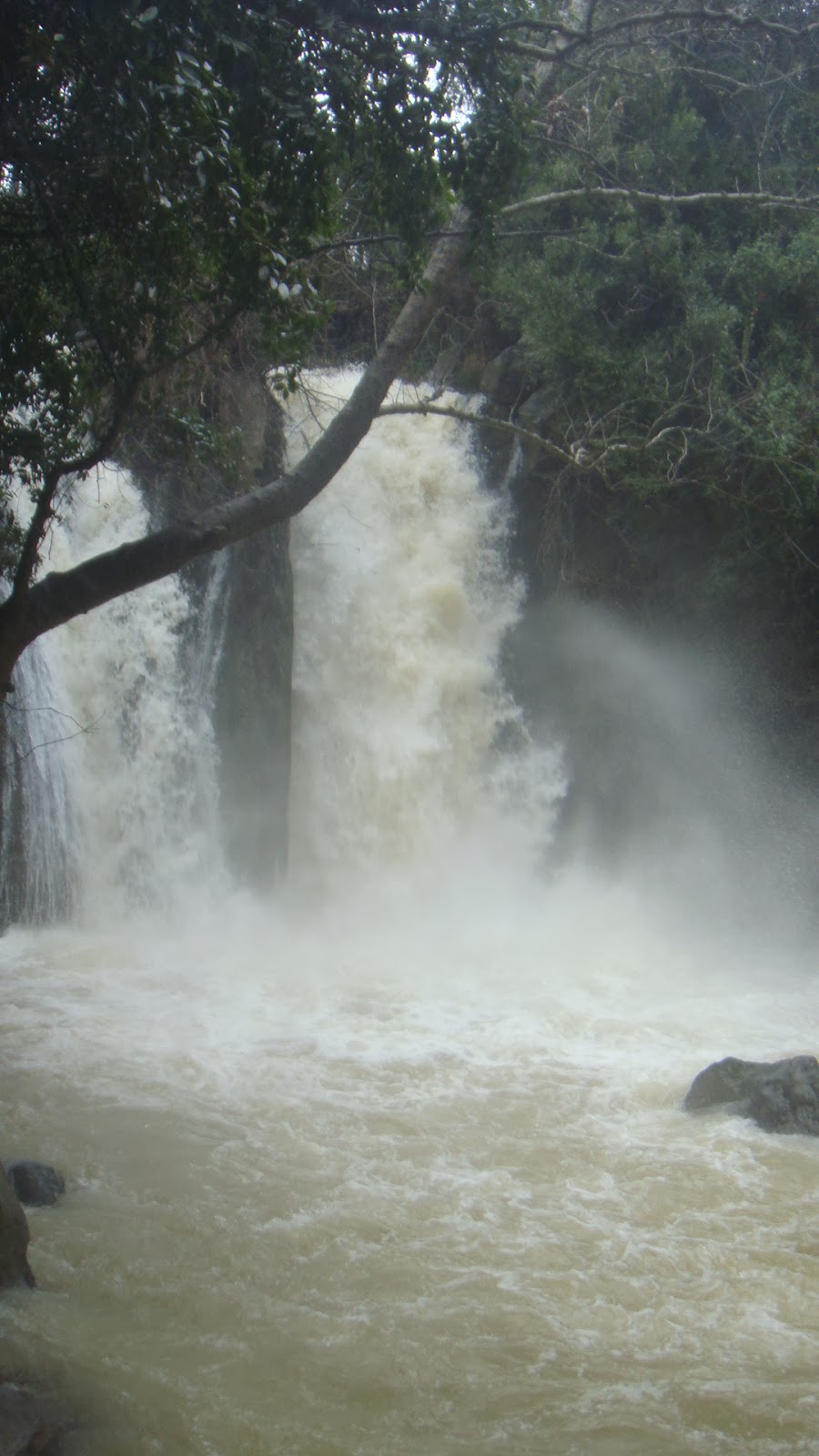
Banias Waterfall


A little bit further to the northeast (and upstream) in the Reserve where the springs emerge as surface water is the Temple of Pan built in 3rd Century BC.
Temple of Pan

Water pools near Temple


We drove past Nimrod's Fortress, which actually has nothing to do with Nimrod (Noah's great-grandson) on our way to Mount Hermon. The road to Mt Hermon passes through Majdal Shams, a Druze village that services the ski population. We didn't get to Mt Hermon and it was shrouded in fog so the views were limited.

The road to Mt Hermon


Then we drove down the Golan with limited views of Syria. Along the Syrian border there is evidence of the contested nature of the territory in the form of road barriers...


That afternoon, further south in the Golan, we went for a wine tasting and stayed the night at a kibbutz. The next day we drove down to the Sea of Galillee where spring was in full force and the fog lifted. We stopped at Capernaum where Jesus is meant to have done some healing after a teaching.


Cliffs near Migdal (just north of Tiberias)

Cliffs near Migdal
 And finally, we drove down Hwy 90 through the West Bank and then west on Hwy 1 up out of the Jordan Valley to Jerusalem. A long, great weekend.


Wednesday, October 30, 2013

Autumn in Jerusalem

Autumn officially started for me this morning. The nights have been cool this past week dipping to 15C (I know, I know) chilling the apartment I'm staying in. I have put an extra blanket on my bed. And, I've had my heavy slippers on in the evenings to insulate against the cold tile floors. (If you know me, you know about my cold feet and love of blankets.) I even started a knitting project last night! But, only this morning when I had an early morning shower that was tepid did it really occur to me that the seasons have changed.

In summer you can count on the solar panel on the roof to give hot water on demand anytime, even in the middle of the night. Yesterday was the first somewhat cloudy day we've had (and by cloudy, I mean a day that would be described in Canada as sunny with cloudy periods, but here as cloudy with sunny periods). And, it was dusty. So, it would seem, the solar heater didn't get its usual hit of energy. Therefore my shower was not as hot as I like it it might have been. All that to say it's autumn. Tepid showers or turn the boiler on!

Tuesday, October 29, 2013

Courage or Conspiracy?

Okay, not exactly the neighbourhood, but in the region. 

Hats off (or hijabs?) to the Saudi women who made Saturday, October 26 a day of protest and drove themselves around flouting the national law that prohibits women from driving.

Yup, a few-several-dozens (??) (it's not clear how many) courageous ladies (who learned to drive elsewhere) got behind the wheel of a motor vehicle and drove it. In most cases not too far, but still, the very act itself is powerful. This small action day is possibly a revolutionary practice.  And it certainly (and obviously) offended religious clerics who claimed women driving is a conspiracy.  

Go Saudi women drivers!!